$8,400 Last Month With Shopify. The 5 Claude Methods Nobody Is Talking About.

I'm not a guru. I don't have a course. I'm just someone who's been running a Shopify store for a few months and figured out that most people use Claude for the boring 10% of what it can actually do.
Everyone writes product descriptions with it. Fine. But that's the least interesting thing it does for a store.
Below are five methods I actually use. Some replaced tools I was paying for. Some replaced decisions I was making badly on my own. The whole stack costs $20 a month.
First - the honest version of the numbers. Month one was $1,200 in revenue. After ad spend and fees I basically broke even. Month two was better. Month three I cleared $8,400 in revenue and kept $3,485. Not retirement money. But the system works and it compounds.
Here's what's inside it.
- Competitor autopsy before touching anything

Most people find a product, look at what the top seller is doing, and copy it. That's how you end up with the same page, the same angle, and a worse version of someone else's store.
Before I build anything I paste the top 3 listings for my product into Claude and ask it to find what's missing - not what they're doing right, but what gap exists that none of them are filling.
This changed how I pick angles completely.
You get a specific angle that isn't crowded. Not "we have better quality" - an actual position that addresses something the market is ignoring. Build your page around that, not around the product features.
- Mining competitors' bad reviews
Negative reviews from your competitors are the best free market research you can get. Most people read them and move on. I paste them into Claude and pull a system out of them.
The pattern is always there. Same complaint, different words, across dozens of reviews. That pattern tells you what to fix before your first sale - or what to avoid in your supplier entirely.
Fix the problem upstream if possible, or address it directly on your page. If the main complaint is "took 25 days" - your page says exactly when it ships and why. Preempting objections converts better than ignoring them.
- Email sequence that runs itself
This is the most underused method in dropshipping. Everyone focuses on the first sale. Nobody builds the system that gets the second one.
A customer who bought once is five times easier to sell to than a cold stranger. But most stores send one order confirmation and go quiet. I set up a five-email sequence once. It runs on its own. I haven't touched it in six weeks. Last month it brought in 22% of total revenue with zero ad spend.
Paste it into Klaviyo, set the triggers once, done. Every customer who buys goes through it automatically.
- Ad script that doesn't look like an ad
The best performing ads right now look like someone filmed something on their phone by accident. No studio. No voiceover. No logo animation.
The problem is that writing a script that actually feels real is harder than it sounds. Claude defaults to marketing language if you don't push back. This prompt pushes back.
Shoot three or four versions in one evening. Change only the opening shot each time. Run each at $10/day for 48 hours. Kill the ones with weak CTR. Put everything behind the winner.
- Sunday diagnostic
This is the one that compounds everything else.
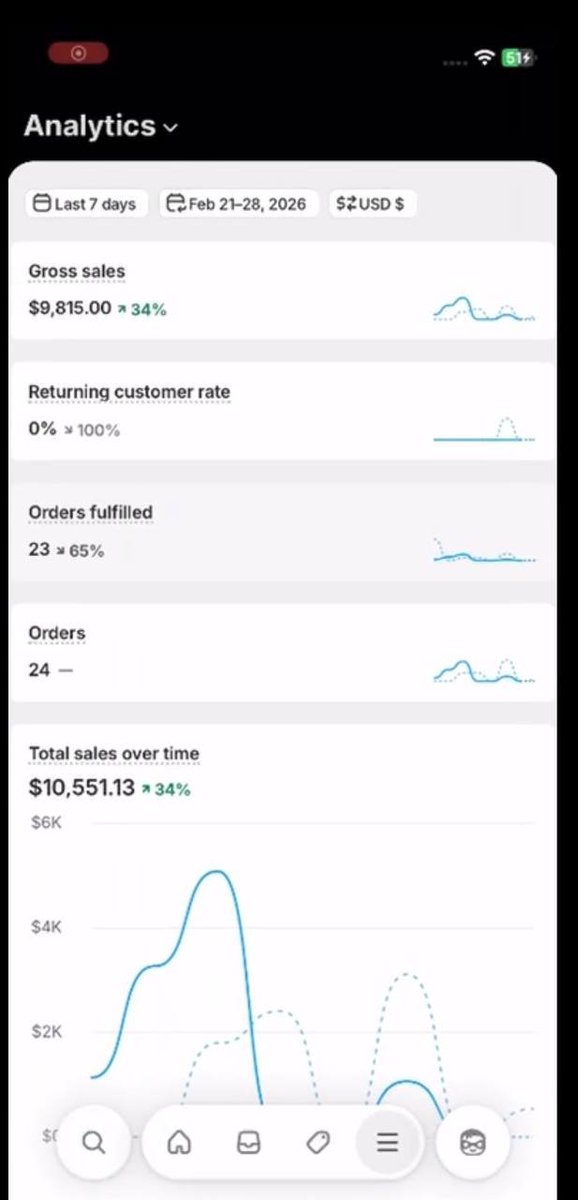
Once a week I export my Shopify analytics and paste the numbers into Claude. It tells me what's broken, what to scale, and what I'm doing wrong - directly, without the softening I'd give myself if I was reading my own data.
The hardest part of running a store alone is that nobody tells you when you're making a mistake. This prompt does that.
20 minutes every Sunday. Paste the numbers. Read the output. Pick one thing to fix. That's it.
Month 1: $1,200. Month 2: $3,800. Month 3: $8,400.
The store didn't change. The product didn't change. Each method just got a little sharper every week.
What this won't do
This isn't passive income. I spend eight to ten hours a week on the store. The prompts don't run themselves - you still make the calls.
Claude doesn't fix a bad product. If the product doesn't solve a real problem, none of this helps. Walk away early if the data says so.
The first month will probably be rough. Mine was. Expect to break even or lose a little for the first four to six weeks. That's not failure - that's how you find out what works.
And this doesn't scale forever solo. At some point you need help or different systems. These five methods are for building something real from zero - not for running a $500K operation alone.
The takeaway
I'm still building this. The numbers are real but they're not huge yet.
What I know for sure: the stores that die are the ones where the owner is the bottleneck in every decision. Product research, ad scripts, email sequences, weekly analysis - all of that used to take most of my week. Now it takes a few hours.
The five methods above are how I got there.
I share more about this process on my Telegram - https://t.me/GipArcAI
Prompts
Monthly revenue:               $8,400
Cost of goods (33%):          -$2,772
Shopify + payment fees:          -$294
Ad spend:                      -$1,800
Claude Pro:                       -$20
Shopify subscription:             -$29

Net profit:                    $3,485
Write a 40-second vertical video script for TikTok and Reels.
Product: [name and one-line description]
Target viewer: [specific person in specific situation]
Style: UGC. Phone camera. Real apartment.
It should not sound like a script.
Normal household items visible in background.
This is not a commercial.
Structure:
0-4s: Show the problem. No talking. Just the moment
the pain hits. Viewer thinks "that's me"
before anyone speaks.
5-14s: Talk about the problem. First person.
Specific situation, not general complaint.
15-24s: "I tried [real alternative 1] and [real
alternative 2]." Name real products.
Be honest about why they didn't work.
25-34s: The product. One function. One continuous shot.
No cuts. No zoom.
35-40s: One specific result. One sentence CTA.
No pressure.
After the script: give 4 alternative opening shots (0-4s).
Each must be a visual action, not a question or statement.
Banned: "game changer," "you need this," "I found the secret,"
"this changed my life," "are you tired of," "did you know."
If any of these appear, rewrite from scratch.You are a product researcher analyzing customer reviews.
Below are 20-30 negative reviews (1-3 stars) for a product
I'm considering selling.
Find:
1. The single most common complaint (exact pattern, not summary)
2. Second most common complaint
3. Any complaint that is a product defect vs a shipping issue
4. What customers expected vs what they actually got
5. Two specific things I could address on my product page
that would reduce these complaints before they happen
Format: short paragraphs, no bullet points.
Be specific. Quote the reviews where relevant.
Reviews:
[paste 20-30 negative reviews from competitor listings]You are an e-commerce analyst. I'm giving you one week
of store data. Find what's broken and say it directly.
Data:
Unique visitors: [X]
Conversion rate: [X%]
Average order value: $[X]
Cart abandonment rate: [X%]
Returning visitors: [X%]
Top 3 products by revenue: [name, revenue, units]
Top product by returns: [name, return rate]
Traffic sources: [breakdown]
Ad spend: $[X]
Revenue from paid traffic: $[X]
ROAS: [X]
Answer these 6 questions. One paragraph each.
1. Where is the biggest leak in my funnel right now?
2. Which product do I scale this week and why?
3. Which product do I pause this week and why?
4. Is my paid traffic finding buyers or just browsers?
5. What does my returning visitor percentage tell me
about whether this store has real product-market fit?
6. If I change nothing for 14 days, what breaks first?
No encouragement. No "this is normal for early stage."
No bullet points. Full paragraphs only.
If something is obviously wrong, say it directly.Write a 5-email post-purchase sequence for a Shopify store.
Product: [name and what it does in one line]
Customer: [who bought it and their situation]
Shipping time: [X] business days
Tone: real person, not corporate. Short sentences.
No "we value your business." No "as per our policy."
Email 1 - immediately after purchase:
Confirm the order in plain language. Set realistic shipping
expectations. One sentence about what to expect on arrival.
No upsell yet.
Email 2 - day 3:
One usage tip they probably don't know. Genuinely useful,
not marketing. Under 80 words.
Email 3 - day after delivery:
Check in. One question: how is it?
No links, no offers. Under 40 words.
Email 4 - day 14:
Soft intro to one related product. Explain why it pairs
with what they bought. No discount, no urgency.
Email 5 - day 30:
Ask for a review. Tell them exactly what to write about.
One line CTA.
Each email: subject line plus body.
Under 100 words per email.
No emojis. No all-caps. No "LIMITED TIME."You are a senior e-commerce strategist.
I'm about to enter this product market. Below are the top 3
competitor listings for this product.
Analyze each one and tell me:
1. What angle are they all using? (1 sentence each)
2. What customer pain is nobody addressing directly?
3. What trust signals are missing across all three?
4. What would make a buyer choose a new store over these?
5. One specific angle none of them are using that could work.
Be blunt. If all three listings are good, say so.
No generic feedback like "better photos" or "add reviews."
Be specific to these exact listings.
Listings:
[paste competitor 1]
[paste competitor 2]
[paste competitor 3]Links
Related articles

the 4,000 year old pattern across EVERY viral youtube video
what if every script you've ever written is a remix of storytelling techniques that are older than the pyramids?

how we're engineering KILLER google ads funnels with fable 5
fable 5 is Anthropic's most capable model ever released to the public.

A CLAUDE AGENT CAN FIND THE $30K ZIP CODE A FRANCHISE IS IGNORING
Imagine you own a franchise with 27 clinics, looking at another report, and saying: