Claude + World Cup = $10K/Month

The World Cup ends in five days.
Most people think that means the YouTube opportunity is disappearing.
It is not.
The easy clip-farm window is closing. Channels copying goals, interviews and FIFA footage risk leaving with Content ID claims, reused-content problems and an audience that disappears after the final.
The real opportunity is turning the remaining attention into an original football media channel.
One match can become a preview, tactical breakdown, player story, rules explainer, long-form video and five to eight Shorts. Claude handles the research structure, scripts, titles and repurposing while you add original narration, graphics and licensed footage.
The goal is not to make $10,000 from five remaining days.
The goal is to use those five days to launch a channel that keeps publishing through the final, transfer window, club season and the next Champions League cycle.
The World Cup supplies the attention.
Claude turns it into a content machine.
Part 1. Why World Cup clip farms fail
The easiest-looking model is also the weakest.
Take a FIFA video, cut the best moments, add captions and upload everything as Shorts. It looks scalable because the source footage already exists and the audience already wants it.
But you do not own the footage.
YouTube automatically scans uploads through Content ID. When copyrighted material is detected, the rights holder can block the video, track it or collect the advertising revenue.
Changing the aspect ratio, adding subtitles or cutting a match into shorter clips does not automatically make the content original.
The second problem is monetization. YouTube can reject channels built around reused or repetitive content when the creator has not added enough original value.
That means the clipping tool is not the business.

The original layer is the business: your research, script, narration, opinion, graphics and presentation.
Use match footage only when you have permission or the correct license. Otherwise, build around statistics, tactical diagrams, licensed images, press conference material you are permitted to use and original visual explanations.
The safest channel is also the most valuable one because viewers return for the analysis, not for footage they can find everywhere else.
Part 2. Three channel formats that can survive the tournament
Do not build a general football channel. Pick one clear audience and one repeatable format.
Format 1: Football explained for new fans
The World Cup brings millions of casual viewers into football. They search questions experienced fans consider obvious:
What is offside?
Why was that goal disallowed?
How does added time work?
Why did the manager change formation?
What happens after a draw?
Why are yellow cards important later in the tournament?
These videos do not require match footage. You can explain everything with diagrams, simple animation, stock footage and original narration.
The topics also survive after the tournament because new fans keep searching them throughout the club season.
Format 2: Player and country stories
Instead of reporting the score, explain why people should care.
Turn one player into a story about where he started, the setback that nearly ended his career, the tactical role he plays and what the tournament changed for him.
The same model works for countries:
Why this team consistently overperforms

How one generation changed a national program
Why a country plays a specific tactical style
The player who became a national symbol
What this World Cup means for the next generation
These stories can use photographs, maps, timelines, statistics and original graphics rather than copyrighted match clips.
Format 3: The tactical and data newsroom
This is the fastest format around live matches.
Before the game, publish the tactical preview. After the game, explain the one decision that changed it. The following day, turn the best insight into Shorts.
The advantage is speed. Large media channels move slowly because every script passes through a team. A focused creator using Claude can turn verified match information into an original breakdown while the search demand is still climbing.
Pick one format first. Mixing rules explainers, transfer rumors, highlights and player biographies on the same new channel makes it harder for YouTube to identify the audience.
Part 3. One match becomes a content machine
A match should not produce one upload.
It should produce an entire content package.
Start with a source document containing the official match statistics, starting lineups, manager quotes, injuries, tactical observations and links to every source. Claude should work only from this package, not invent missing information.
From the same research, create:
One 7 to 10-minute YouTube breakdown
One pre-match or post-match video
Five to eight Shorts
Three alternative hooks
Five titles

Three thumbnail concepts
One community post
One X post
A follow-up topic for the next day
The long-form video is the main asset. It builds watch hours and creates the deepest relationship with the audience.
The Shorts are distribution. Each one isolates a single surprising statistic, player decision, tactical change or controversial moment and sends new viewers toward the complete breakdown.
The X and community posts test the strongest claims before the next video. If one argument creates disagreement, that argument becomes tomorrow’s Short.
This is the loop:
Research once → publish everywhere → measure the reaction → turn the strongest reaction into the next video
Claude is not replacing the creator.
Claude is operating the newsroom around the creator.
Part 4. The Claude workflow
Prompt 1: Build the verified research brief
This prompt separates research from writing. Claude first creates the factual foundation, then uses it to produce content.
Prompt 2: Write the long-form video
Prompt 3: Turn the video into Shorts
Prompt 4: Create the visual plan
Prompt 5: Generate the post-tournament pivot
Part 5. The production stack
The stack does not need to be complicated.

Claude handles research organization, scripts, hooks, titles, repurposing and the publishing calendar.
A voice tool handles narration, or you record your own voice for stronger identity.
Canva, Figma or another graphics tool creates maps, player cards, timelines and tactical diagrams.
CapCut or DaVinci Resolve assembles the narration, graphics, licensed material, captions and music.
YouTube Studio provides the only performance data that matters: click-through rate, average view duration, retention drops, returning viewers and traffic sources.
Do not automate the judgment layer.
Claude can generate ten titles, but you still decide which promise is strongest. It can produce six Shorts, but you still remove the ones that repeat the same idea. It can organize statistics, but every current fact still needs verification.
The production advantage comes from reusable templates.
Build one thumbnail system, one tactical diagram style, one player timeline and one editing structure. After that, every new match changes the information, not the entire production process.
Part 6. Monetization and the path to $10K/month
YouTube does not pay a new channel immediately.
For full advertising revenue through the YouTube Partner Program, the standard path requires 1,000 subscribers plus either 4,000 valid public watch hours during the previous 12 months or 10 million valid public Shorts views during the previous 90 days.
Shorts watch time from the Shorts feed does not count toward the 4,000-hour long-form requirement.
That is why the channel should combine both formats:
Long-form videos build watch hours and generate stronger advertising revenue.
Shorts create discovery and send viewers toward the longer videos.
The $10K/month target requires real scale.
Using a sample $4 long-form RPM:
300,000 monthly views = approximately $1,200
1 million monthly views = approximately $4,000

2.5 million monthly views = approximately $10,000
The RPM is an assumption, not a guarantee. It changes with viewer location, video length, advertiser demand, season and audience profile.
The real target is not one viral Short.
It is a library of original long-form videos that continues collecting search and recommendation traffic after the final.
When the tournament ends, publish the consequences:
The players whose careers changed
The teams that need rebuilding
The tactical ideas clubs will copy
The transfers influenced by the tournament
The young players to follow next season
What the tournament revealed about modern football
The audience should feel that the story continues even when the trophy has been lifted.
The World Cup gives you borrowed attention.
Claude helps convert that attention into a publishing system.
The channel is the asset that remains.

Prompts
This channel was built around World Cup content.

Channel format: [FORMAT]
Best-performing topics: [TOPICS]
Audience: [AUDIENCE]
Average view duration: [DATA]
Top traffic sources: [DATA]

Create a 30-day post-tournament content plan.

The plan must move naturally into:

- Player career stories
- Transfer analysis
- Tactical lessons from the tournament
- Club football
- Champions League narratives
- Evergreen football explainers

For each video provide:

1. Title
2. Core hook
3. Why the existing audience will care
4. Long-form or Shorts format
5. Follow-up opportunity

Avoid topics that require unlicensed match footage.
You are the research editor for a football YouTube channel.
Topic: [MATCH, PLAYER OR STORY]
Use only the sources pasted below. Do not use outside knowledge and do not invent missing statistics, quotes or events.
Sources:
[PASTE OFFICIAL STATISTICS, ARTICLES, QUOTES AND LINKS]
Create a verified research brief containing:
1. The 10 most important facts
2. The central conflict or question
3. Three surprising statistics
4. The tactical or historical context
5. The strongest argument for each side
6. Any claims that cannot be confirmed
7. Five possible video angles ranked by potential viewer interest
Mark every unsupported statement as NEEDS VERIFICATION.Convert this football script into a visual production plan for a faceless YouTube video.
Available assets:
- Licensed photographs
- Stock football footage
- Maps
- Player and team statistics
- Original tactical diagrams
- AI-generated backgrounds
- Animated text
For every 10 to 15 seconds provide:
1. Visual type
2. Exact information shown
3. Camera movement or animation
4. On-screen text
5. Source required
Do not suggest copyrighted match footage unless it is explicitly listed as licensed.You are writing a faceless YouTube video for football fans.
Use only the verified research brief below.
Topic: [TOPIC]
Target length: 8 minutes
Audience: [NEW FANS / PLAYER-STORY VIEWERS / TACTICAL FANS]
Structure:
Opening: Begin with the most surprising verified fact or conflict. Do not say "In this video" or "Welcome back."
Context: Explain why the topic matters right now.
Main section: Build three connected arguments. Each section must introduce new information.
Turning point: Reveal the decision, statistic or event that changes how the viewer understands the story.
Conclusion: Explain what happens next without using a motivational closing.
Style: conversational, specific and confident. Avoid generic football clichés.
Output the complete voiceover script with short visual notes in brackets.Turn the long-form script below into six original YouTube Shorts.
Each Short must:
- Cover one complete idea
- Run for 35 to 55 seconds
- Open with a specific fact, conflict or prediction
- Work without footage from the match
- Include suggestions for statistics, maps, diagrams or licensed images
- End with a conclusion or debatable question
Do not summarize the entire long-form video.
Make every Short useful as an independent piece of content.
For each Short provide:
1. Hook
2. Full voiceover
3. Visual sequence
4. On-screen text
5. Title under 60 characters
Script:
[PASTE SCRIPT]Related articles

the 4,000 year old pattern across EVERY viral youtube video
what if every script you've ever written is a remix of storytelling techniques that are older than the pyramids?
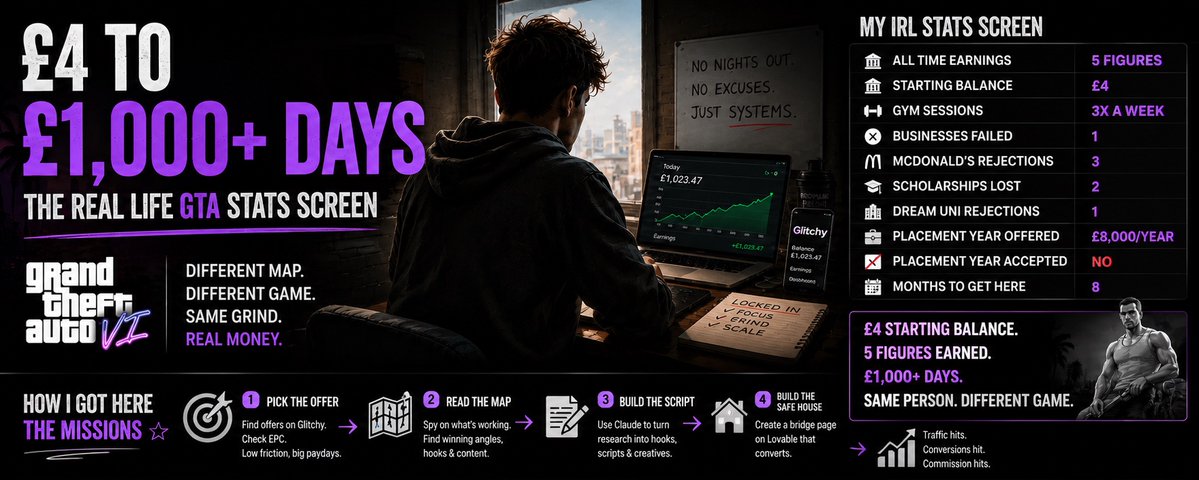
GTA VI has a stats screen. so do I. mine shows £1,000+ in a day.
everyone's booting up GTA VI right now.

the new way to blitzscale google ads (at 21x ROAS)
i'm watching brands spend $10k, $20k, $50k/month on google ads and send every single click to a product page.