How to become an AI Engineer in 2026 - without a CS degree

The highest-paid building role in tech right now doesn't care what your diploma says. It cares what you've shipped. Here's the exact 12-month path.
Most people think you need a computer science degree to work in AI. A small group figured out that the highest-paid building role in tech right now doesn't care what your diploma says - it cares what you've shipped. The difference between those two groups is not credentials. It is a portfolio.
An AI engineer builds the systems that connect large language models to real products. The support bot that actually resolves the ticket. The internal search that finds the answer buried in ten thousand documents. The agent that runs a multi-step workflow without a human babysitting it.

This is not research. It is not training models from scratch. It is building production software with AI at the core - and it is one of the most in-demand jobs in the entire market.
Here is the part nobody told you. For the majority of these roles, a portfolio of shipped projects carries more weight than a degree. Hiring managers will tell you plainly: they've watched self-taught engineers run circles around PhD holders, because shipping is a different skill than studying. The credential gate is mostly an illusion, and the people who realize it early get years ahead.
This is the path. No degree required. Here's exactly what it looks like.
Builder, not scientist


Most people aim at the wrong target. Two roles get confused. The machine learning researcher invents new models and trains them - that work genuinely benefits from advanced degrees and heavy math, and it's a small slice of the market. The AI engineer takes models that already exist and builds useful things with them - that work rewards software skill, product sense, and shipping discipline far more than academic credentials.
The role sits at the intersection of three things: software engineering, a working understanding of how language models behave, and product thinking. You don't need to be elite at all three on day one. You need to be competent and improving - and you need proof.
→ The 12-month build track
Six phases. Ship every one.


Twelve months is a real timeline - and it only works if you're building the entire time. Amber nodes below mark a phase that ends with a shipped portfolio project.
Retrieval-augmented generation
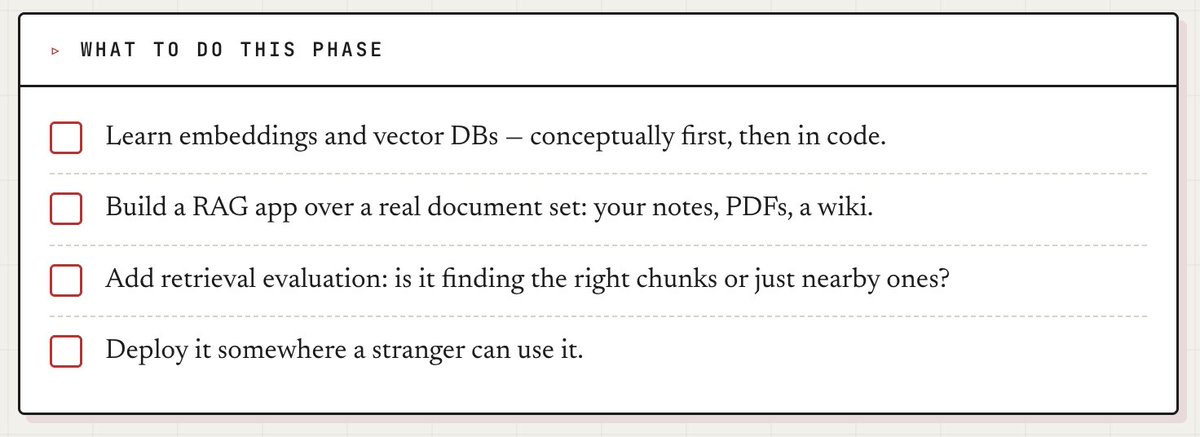
A model only knows what it was trained on and what you put in front of it. RAG fetches the right information from your data and puts it in front of the model - so it answers accurately about your company's documents, a product manual, a knowledge base.
You break documents into chunks, turn them into embeddings, store them in a vector database, and retrieve the most relevant ones for any question.

A model with tools and a loop
A RAG app answers a question. An agent gets a job done. It takes a goal, breaks it into steps, uses tools to complete each step, and decides what to do next based on what happened.
You already learned tool use in Phase 2 - now you put it in a loop and handle the messy reality that agents sometimes go in circles, call the wrong tool, or get stuck.
Three shipped projects > a master's degree
By now you have three real projects: a RAG application with evaluation, a multi-agent system that solves a real problem, and a deployed system with monitoring. Write each up as a clear case study - problem, approach, what you measured, what you'd do differently. Then apply, starting with an AI-augmented software role as a realistic first step.
When the interview asks you to "reason about how an agent should handle a tool failure" or "explain how you'd evaluate a RAG system," you won't be reciting theory. You'll be describing what you actually did. That's the whole game.
The credential gate keeping most people out is one most companies have already stopped enforcing.
Like,book and follow @0xClodex
Related articles

my ULTIMATE claude code setup (after months of daily use)
I've been using this setup every single day for months. never showed anyone the full thing until now. here's exactly what it is.

how creators can ACTUALLY grow their business with AI
Writing pieces people search for.

How to get more out of your AI agents...
the intelligence of frontier models is not a bottleneck & it hasn't been for a while...