how to ghostwrite for founders (step-by-step guide)

Over the last 6 months, I've generated over 15 million views and 25K+ followers on X for 3 founders including the CEO of Wispr Flow (@tankots).
Ghostwriting has quickly become one of the most highly sought after roles as founders look to grow their online presence.
However, not many people know how to do it.
Growing a personal brand is relatively straightforward, but training to do it for someone else is a lot more complicated.
If you want to become a ghostwriter or you are a founder looking to hire one, this guide will walk you through everything I practiced.
Here's the full blueprint.
I. Adopting founder voice
Before you think about writing posts, you need to understand how your founder wants to be represented on social media.
Not everyone wants to be as controversial as Roy Lee - some may prefer to be humble and some may want to showcase wins to build authority.
Beyond simply asking the founder for their preferences, the real method is to do what I like to call "post walkthroughs".
Post Walkthrough: Find pieces of content written by similar people in your niche and discuss the founder's thoughts and opinions on how it aligns with the way they want to be represented.
Everyone has their own forms of content that they would enjoy reading - by talking through various posts, it's easy to see what those preferences are for someone else.
II. Study existing content
When I worked for Tanay (CEO of @WisprFlow), the first week consisted of going through his LinkedIn and X and reading all of his old posts.
When you write a post, respond to a comment, or engage with content, you need to understand how the founder sounds as they write so it feels authentic to their audience.
Do they like feeling more corporate and serious? Do they include more jokes and viral trends in their writing? Do they usually include pictures with their posts?
Everyone has their own unique patterns that break the flow when someone comes across your content. You may not realize it, but people can tell who posted just from the way it is written.
Remember you are a ghost-writer - a founder's worst nightmare is content that doesn't sound like them.
People stop scrolling when they see your name or style of writing because they understand: "I like this person, let me see what they have to say."
Patterns are important - expanding on that in step IV...
III: Create an inspiration bank
Now that you understand all of your founder's preferences, the next step is knowing what to post.
The easiest way to do this is by building an inspiration bank that you can pull from at all times.
By having a source where you can constantly pull inspiration, it makes it easy to avoid writer's block (not knowing what to write).
If you know you want to write an article about product principles, it would be 10x easier if you could see how other informative articles were written. If you want to write a storytelling thread, you can take inspiration from how other posts break up the story.
An easy way to build this bank is to use X's advanced search feature to set a minimum number of impressions.
You can also directly type into your search bar your topic and add either "min_faves:100" (likes), "min_replies:100" (comments), or "min_retweets:100" to filter out posts that had under a certain amount of impressions (in this case 100).
Most posts you see on your feed are there for a reason: strong engagement, well written, valuable content, etc.
Keep them ready, you never know when they'll come in handy.
IV: Identify viral triggers
Viral formats do well because people instinctively assume they will enjoy similar pieces of content.
If someone sees a post that says "is it possible to make $1 on the internet in 24 hours?", they clearly know what to expect and stay to watch the result.
Your job is to find the patterns that make a post go viral and implement them in your unique style.
Here is an example of a post I wrote:
the inspiration:
In this example, the orange carpet and gooseneck microphone in @alliekmiller's post automatically signal that this is Wispr Flow's office. I remember reading Allie's insights and being intrigued since Wispr works differently than most other companies.
In my case, I have a very similar looking picture - signaling there is another unique insight you should stop to read.
The result? 250K+ impressions.
The goal here is to take recognizable elements from viral posts and recreate them in your own way. This could be certain phrases, images, or formats.
"What about creating new formats? I thought I had to be original."
Following post structures that have repeatedly gone viral is extremely common. The pitfall to avoid is posting slop or unoriginal content that rips off someone else.
This article you are currently reading could be classified as a "viral structure" because it's an informative article, but the content is completely original.

When I was at Wispr, I used a 3:1 ratio of trendy tweets to experimental. This means for every 3 tweets that used a viral format, I would have 1 experimental post to try something new.
Your experimental post is meant to try new formats to keep your profile feeling fresh and personal - while also potentially creating a trend for others to follow.
V: Create genuine value
This is the most important part of growing an account.
At the end of the day, people are selfish and want to digest content that will improve their life in some way. This could be entertaining videos, educational insights, or relatable struggles.
The easiest way to do this is to dig into your founder's experiences and pull out insights that are fresh and unique.
Maybe they went to art school and learned an unconventional design exercise they use every day.
They pivoted out of a completely unrelated career in order to start this company.
They have unique rules as part of their company's culture that enable them to be successful.
They swear by doing a certain activity every day (cycling, meditating, etc)
Examples I've written:
The difference between content that gets ignored and content that gets saved is whether you're saying something new.
By utilizing your unique background, you are guaranteed to say something that nobody or very few have said before.
This sparks conversation, engagement, and bookmarks, which all lead to a more successful post.
VI: Post often, not always
Every post you make is a data point.
If you aren't a world renowned founder, chances are, only a fraction of the posts you make will go viral.
And that is completely normal.
The way to combat this is to find a posting cadence that enables you to iterate and test ideas fast while not to swarming your audience with posts.
Growth operators have very differing opinions on posting schedules (a couple times a week vs. every day vs. multiple times a day).
In my personal experience, I've found that three high-effort posts a week works best, supplemented with comments and quotes throughout the week.
Monday: Article / Best content of the week

Tuesday: Quote Retweet, Comment
Wednesday: Thread / Long-form Reflection
Thursday: Quote Retweet, Comment
Friday: Thread / Experimental Post
Saturday / Sunday: No Posts
This is self-explanatory but most people are checking X on the weekdays to stay updated on news (especially Monday). By spacing out your high effort posts, you give each post time to breathe before dropping the next one.
Spacing out high-effort content also signals that you spent time and energy to write your posts.
If you are posting lengthy articles every 24 hours, how much effort did you really spend on each one?
Your audience notices these things.
VII: How to communicate with your founder
Once you understand your founder's preferences and how to write content, the next step is creating a sustainable workflow with your founder.
Founders are extremely busy. The goal should always be to write high-quality posts while requiring minimal involvement from the founder.
The dynamic I practiced at all three companies was to batch posts before the start of each week. Rather than writing and reviewing a post every time one is finished, write all posts for the week and send them in a batch.
Usually, I draft up posts in a tool called Typefully (unsponsored) that allows you to see exactly what your post will look like on the timeline.
This allows the founder to see all posts at a glance, input comments, and schedule posts on one platform.
"What happens if I run out of content ideas?"
If you find it hard to come up with new posts, prepare 10-20 questions to ask your founder to spark new ideas.
All of us have unique stories or backgrounds that we can share, but they can only be unlocked by asking the right questions.
Here are some i've used:
What's a weird company tradition/practice that you've implemented?
What unscalable efforts were essential in getting your company off the ground?
What's something everyone in your industry believes that you think is wrong?

What skills did you develop at a young age that helped you become successful now? What activities built that skill?
Make the founder's job as easy as possible. Pack each meeting with all the to-do's, questions, or comments you have and move forward proactively.
VIII. Understand the impact of each impression
You now understand how to set up the workflow and write tweets.
But once a post goes live, the job is not finished.
There are a variety of ways to increase the probability of success for a post.
The two most important are:
- Quote Retweets
Quote retweets are one of the easiest ways to boost impressions on a post. If your original post has 100k impressions on its own, and someone quotes it and gets 50k impressions, your original post's analytics will show ~150k total impressions (the quote's views count toward the original).
Most of the viral content I've seen with 500K+ impressions had about 1/3 of the impressions organic from the audience and 2/3 from quote retweets.
- Responding to Comments
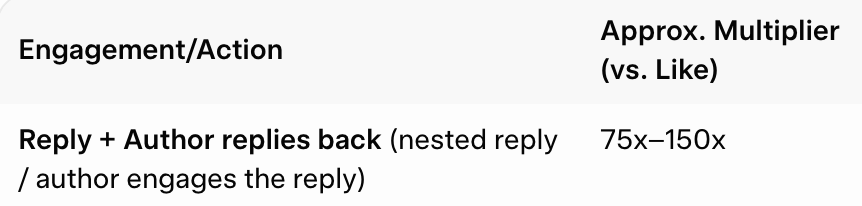
In a previous article, I explained how each engagement has a different "value" that increases the reach of a post.
Author replies are the highest multiplier impression because it signals that you are active with your community and sparking conversation.
Even if it's as simple as an emoji, try your best to reply to everyone.
For both of these engagements (quotes and responses), it is important to have access to your founder's account.
Engaging with content requires you to be chronically online, and having to ask them to respond creates more overhead for both sides.
IX: Repurpose posts across platforms (LinkedIn, X)
Finally, don't be afraid to repurpose content.
Not all founders like to post on LinkedIn, but if they do, it is normal to reuse posts that have gone viral on X to LinkedIn and vice versa.
Some may argue that each platform has their own algorithm and sense of humor (which is true), but valuable content as we discussed (providing value, unique insights, etc) is universal.
In my experience, the main difference between LinkedIn and X are:
Capitalize sentences on LinkedIn
Understand at what line your post is truncated (where does it say "show more")
Focus on bewildering/unique insights - in a sea of overly-formal posts, it stands out
Tanay has over 100,000 followers on LinkedIn which is a bigger following than 99.9% of founders on X.
People like to clown on LinkedIn, but you'd be surprised how many investments, potential hires, and opportunities come through the platform (just ask @fatimahs_tech).
Having a big audience, regardless of platform, is extremely valuable.
TLDR:
Adopt founder voice: run post walkthroughs to learn how they want to be represented
Read existing content: study their old posts until you can write like them
Create an inspiration bank: save viral posts to pull from (use min_faves search)
Identify viral triggers: borrow proven formats, 3:1 trendy to experimental
Create genuine value: tell the founder's unique stories and insights
Post often, not always: 3 high-effort posts/week, spaced to breathe
Streamline founder communication: batch weekly drafts in Typefully, minimize their involvement
Engage each post after it's live: quote retweets + author replies multiply impressions
Repurpose across platforms: viral content can travel between X and LinkedIn
--
I've always believed that going viral on any platform is 80% making good content and 20% up to the algorithm.
If you continue to create quality posts, you will inevitably go viral.
Just don't let the things you can control be the issue.
If you have any questions about anything I've shared in this guide, feel free to comment or DM me and I'll respond.
Best of luck :) Embedded post:
Author: Tanay Kothari (@tankots) Post ID: 1990475270344593419 Source: https://x.com/tankots/status/1990475270344593419 Reply to: none
Text:
> we got into YC. then we rejected them. here's why walking away was the best decision i ever made (and might be for you too): > > i was 21, nine months into building Feather X with a plan: raise $2-3M from VCs to scale without massive dilution. > > but then everything happened at once: > > - YC acceptance letter arrives > > - multiple VCs offer better terms than YC > > - a casual "partnership chat" turns into an acquisition offer > > that partnership chat was my mentor from Human Capital connecting me with Cerebra's CEO. > > three months later: there was a bidding war between two companies to buy us. > > the truth is: YC is incredible for founders who need direction, community, and credibility. > > we already had product-market fit. we had revenue. we had buyers. taking YC would have meant dilution for a badge we didn't need. > > so we took the acquisition instead. > > some people called me crazy. "you'll regret not having YC on your resume." > > three years later, that acquisition gave me something better than a badge: > > - experience managing teams twice my age > > - capital to start my next company > > - deep knowledge of enterprise sales > > the YC badge opens doors. but when doors are already opening, you don't need to pay for a key. > > what's right for most isn't always right for you.
Embedded post:
Author: Tanay Kothari (@tankots) Post ID: 2003531072861274249 Source: https://x.com/tankots/status/2003531072861274249 Reply to: none
Text:
> we just hired an intern to doomscroll on twitter 8+ hours a day. > > in today's world, distribution is king. but every platform (X, instagram, tiktok, etc) has a different algorithm to go viral. > > for example: > > > x - look for REPLIES (27x higher boost than likes) > > > instagram - promotes high quality/edited videos; retention is driver > > > tiktok - rewards less formal/more raw content (why ugc does so well) > > that's why we hired a 19 year old to study what makes each piece of content go viral. everything from reading twitter's algorithms to staying updated on the latest memes. > > tech twitter is a tiny bubble, so to get millions of impressions, you need to adapt to what grabs attention. > > cracking the algorithm is the key to distribution.
Media:
Embedded post:
Author: Allie K. Miller (@alliekmiller) Post ID: 2000671547380404606 Source: https://x.com/alliekmiller/status/2000671547380404606 Reply to: none
Text:
> Voice AI is going to explode in 2026. Here’s what I’m seeing: > > 1. Dictation has completely changed how I work > > I go on walks where I dictate to Otter for 40min. I built an app this weekend while lifting weights. The productivity gain is real. > > 2. Phone booths everywhere > > I visited the offices of two large AI companies last week. They have phone booths everywhere. I watched someone walk into one, dictate, then walk right back out. That’s it. > > 3. Microphones at every desk > > I visited Wispr Flow’s headquarters in October (see pic). Every single employee had a $60 microphone on their desk and can whisper tasks all day long to AI. You cannot hear them even if you’re at the neighboring table. > > 4. OpenAI says typing is the bottleneck > > Alexander Embiricos, head of product for Codex, just went on the @lennysan podcast that the “current underappreciated limiting factor” to AGI-level productivity isn’t model capability, it’s human typing speed. > > We are literally being held back by our fingers.
Media:
Embedded post:
Author: Tanay Kothari (@tankots) Post ID: 1993014204375392293 Source: https://x.com/tankots/status/1993014204375392293 Reply to: none
Text:
> when i was 13, google sent me a cease and desist threatening to put me in jail or shut down my app. > > since then, i've raised $81M+ for @WisprFlow. > > here's the story of how i first hustled (thread):
Links
Related articles
The AI Listing Glow-Up Factory: $12,900 a Month Staging Real Estate and Airbnb Homes.
Most short-term-rental listings look dead, and a dead listing bleeds bookings every week it sits. Fixing the look now costs about a dollar a room, and hosts pay hundreds to have it done for them.

The smartest money-move of 2026: build her in 30 min, earn $1,500 per viral. System inside.
A face that doesn't exist can out-earn a real one.

How to Make Money on YouTube Without Showing Your Face (And Let AI Do 90% of the Work)
There are YouTube channels making between $1,000 and $10,000 per month.