how we generated $55k in 90 days with a meta ads advertorial funnel

$55,000 in 90 days. one service business client. one funnel architecture.
ad to advertorial to offer page. three pages total. no complex multi-step funnel. no quiz. no webinar. no 8-page sequence with upsells and downsells and cross-sells.
three pages. and the advertorial in the middle is the reason the economics worked.
the traditional approach, sending cold meta traffic directly to a service page, converts at 1-2% in the best case scenario. the advertorial funnel converted cold traffic at 8-15% for this client because the advertorial did the belief-shifting work before the prospect ever saw the offer.
here's the full breakdown of what was built, why each piece was built the way it was, and the numbers at every stage.
the problem with sending cold traffic to an offer page
the standard meta ads funnel for service businesses: ad drives traffic to a landing page with the offer. the page has a headline, some benefit points, maybe a testimonial, and a CTA button.
here's what the prospect's brain processes when they land on the offer page from a cold ad:
"who is this person?"
"why should i trust them?"
"i don't understand how this works"
"this looks like every other agency page i've seen"
"i'm leaving"
they leave in 3-8 seconds. cost per click is $2-5. cost per conversion is $150-300. at those economics, the math doesn't work for most service businesses under $10k/mo in ad spend.

the problem isn't the ad. the problem is asking a stranger to go from "who are you" to "take my money" in the span of one page. the belief gap between those two states is too wide for a single landing page to bridge.
what the advertorial does (the belief bridge)
the advertorial sits between the ad and the offer page. it looks like an article. it reads like educational content. it functions as a sales mechanism disguised as information.
here's the specific belief shift it creates:
before reading the advertorial: the prospect doesn't understand the problem at a root-cause level, doesn't know the mechanism behind the solution, doesn't trust the person offering it, and has no reason to consider this approach over the alternatives.
after reading the advertorial: the prospect understands why their current approach isn't working, understands the specific mechanism behind the solution, views the person offering it as an authority who's demonstrated expertise, and sees the offer as the logical next step.
by the time they click through to the offer page, 80-90% of the selling is done. the offer page's job drops from "convince a stranger to buy" to "confirm the decision and make it easy to act."
the 6-section advertorial framework (exactly what we built)
section 1: the hook
open with the problem from the reader's perspective. not the offer. the experience they're having right now.
for this client (a service business helping homeowners): we opened with the frustration of getting quotes from three different companies and having no idea how to compare them. the reader is nodding before the end of the first paragraph because the situation is their situation.
section 2: why their current approach fails
destroy the existing belief about the solution. for this client: the conventional advice is "get multiple quotes and go with the cheapest." we explained specifically why the cheapest quote often costs the most in rework, delays, and hidden fees. named the three specific red flags in cheap quotes most people miss.
section 3: the root cause
reframe why the problem exists at a deeper level. for this client: the root cause isn't that contractors are dishonest. it's that the homeowner doesn't have the evaluation framework to distinguish a legitimate quote from a lowball that'll balloon once work starts. the problem is information asymmetry, not vendor quality.
section 4: the mechanism
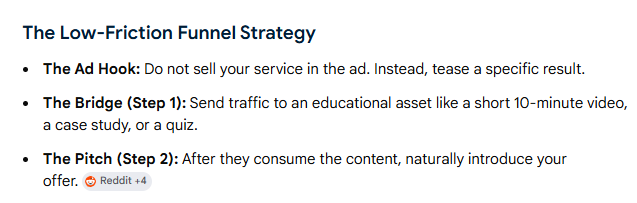
introduce the approach without naming the service yet. for this client: we introduced a specific 5-point evaluation framework homeowners should use to assess any contractor quote. we gave them the framework in full. it was genuinely useful. anyone reading it could use the framework on their own.
section 5: proof
case studies, data, specific results. for this client: we included three specific customer stories (anonymized) where homeowners used the evaluation approach and saved $3,000-$12,000 by catching red flags in competing quotes. each story was specific: the type of project, the initial quote, the red flags found, and the outcome after switching to a provider who passed the evaluation.
section 6: the recommendation
now name the service. position it as the implementation of the mechanism the article explained. for this client: "if you don't want to run the evaluation yourself, [client name] does it for you. they evaluate every contractor in your area, flag the ones who fail the framework, and connect you with the one who passes. here's what their customers say."
the transition from section 5 to section 6 doesn't feel like a pitch. it feels like a recommendation from someone who just spent 2,000 words educating you on how to solve the problem yourself.
the offer page (what the pre-sold prospect sees)
the offer page for an advertorial funnel is structurally different from a cold-traffic offer page because the visitor arrives in a completely different psychological state.
a cold visitor needs to be sold on the problem, the mechanism, the authority, and the offer all on one page.
an advertorial visitor has already been sold on the first three. they need confirmation and convenience.
the page structure we used:
headline matching the advertorial's mechanism (consistency from page to page)
3-5 benefit bullets directly referencing what they learned in the advertorial
social proof section: reviews, logos, or specific result numbers
the offer with clear pricing or a booking CTA
FAQ section addressing the 3-4 remaining objections

the page was deliberately simpler than a typical landing page. fewer words, fewer sections, fewer proof elements. the advertorial already did the heavy lifting. the offer page only needed to make the "yes" easy.
the ad creative (what drove the traffic)
the ads for an advertorial funnel are fundamentally different from ads driving traffic to an offer page.
an offer-page ad needs to sell: the hook promises a benefit, the copy makes a claim, the CTA pushes for action.
an advertorial ad needs to create curiosity: the hook implies a story or an insight, the copy creates an open loop, the CTA promises information rather than a transaction.
the ad hooks we tested (top 3 performers):
"the $12,000 mistake most homeowners make when comparing contractor quotes (and how to avoid it in 30 seconds)"
"a homeowner asked 3 contractors for quotes and found something alarming in every single one"
"this 5-point checklist is saving homeowners thousands on home service projects"
each hook promises information, not a product. the click feels like choosing to read an article, not choosing to view an ad. that psychological framing is critical because it determines the mental state of the traffic when it lands on the advertorial.
someone who clicked expecting to read an article reads the article. someone who clicked expecting a sales page bounces the moment they realize that's what they got.
the numbers (90-day breakdown)
month 1 (the learning phase):
ad spend: $3,200
advertorial completion rate: 48% (target was 50%+, close enough to continue)
click-through rate from advertorial to offer page: 22%

conversion rate on offer page: 9.8%
revenue generated: $11,400
ROAS: 3.56x
month 2 (optimization):
ad spend: $4,100
advertorial completion rate: 56% (after copy optimization on sections 1 and 2)
click-through rate: 26%
conversion rate: 11.2%
revenue generated: $19,800
ROAS: 4.83x
month 3 (scaling):
ad spend: $5,600
advertorial completion rate: 54%
click-through rate: 24%
conversion rate: 10.8%
revenue generated: $23,800

ROAS: 4.25x
90-day total:
total ad spend: $12,900
total revenue: $55,000
blended ROAS: 4.26x
the conversion rate from cold traffic through the advertorial funnel ran at 9.8-11.2% across 90 days. the same traffic sent directly to the offer page (which we A/B tested in month 1) converted at 1.4%.
the advertorial turned 1.4% economics into 10%+ economics from the same cold traffic source. the difference is the belief bridge.
why this structure scales (and complex funnels don't)
the advertorial funnel is three pages. ad to advertorial to offer page.
attribution is clean. low click-through rate? ad problem. low advertorial completion? content problem. low offer page conversion? offer or pricing problem. each page has one job and one metric. diagnosis is immediate.
the content is evergreen. the advertorial doesn't fatigue the way ad creative does. the same article works month after month because the content provides genuine value. what fatigues is the ad driving traffic to it. when the ad fatigues, you refresh the ad and point the new creative at the same advertorial.
scaling is linear. more ad spend = more advertorial readers. the conversion rate at the bottom stays consistent (or improves as the pixel accumulates more high-quality conversion data). there's no complexity threshold where performance degrades because you're managing too many pages.
if you want us to audit your service business and show you how we'd build and run this exact advertorial funnel architecture for your offer, DM me "META" and we'll map out the full build.
($10M+ generated for service-based businesses through meta ads funnels, fully done-for-you)
zack
Related articles

the dark psychology behind winning meta ad creatives
"if you know the enemy and know yourself, you need not fear the result of a hundred battles."
The PS1 Arbitrage: Weaponizing Low-Poly for Conversions
*"Rendered in low-poly PS1-era 3D graphics, mid-1990s PlayStation aesthetic. Chunky low-polygon geometry, stretched and warped low-resolution textures with affine texture mapping distortion, visible…

How to articulate yourself intelligently
I hope that was helpful enough to get you started.