One Shopify store hit $91,340/month by using Claude as the operator, not the writer.
Shopify + Claude is not about product descriptions.
That is the part everyone sees first, so that is the part everyone copies.
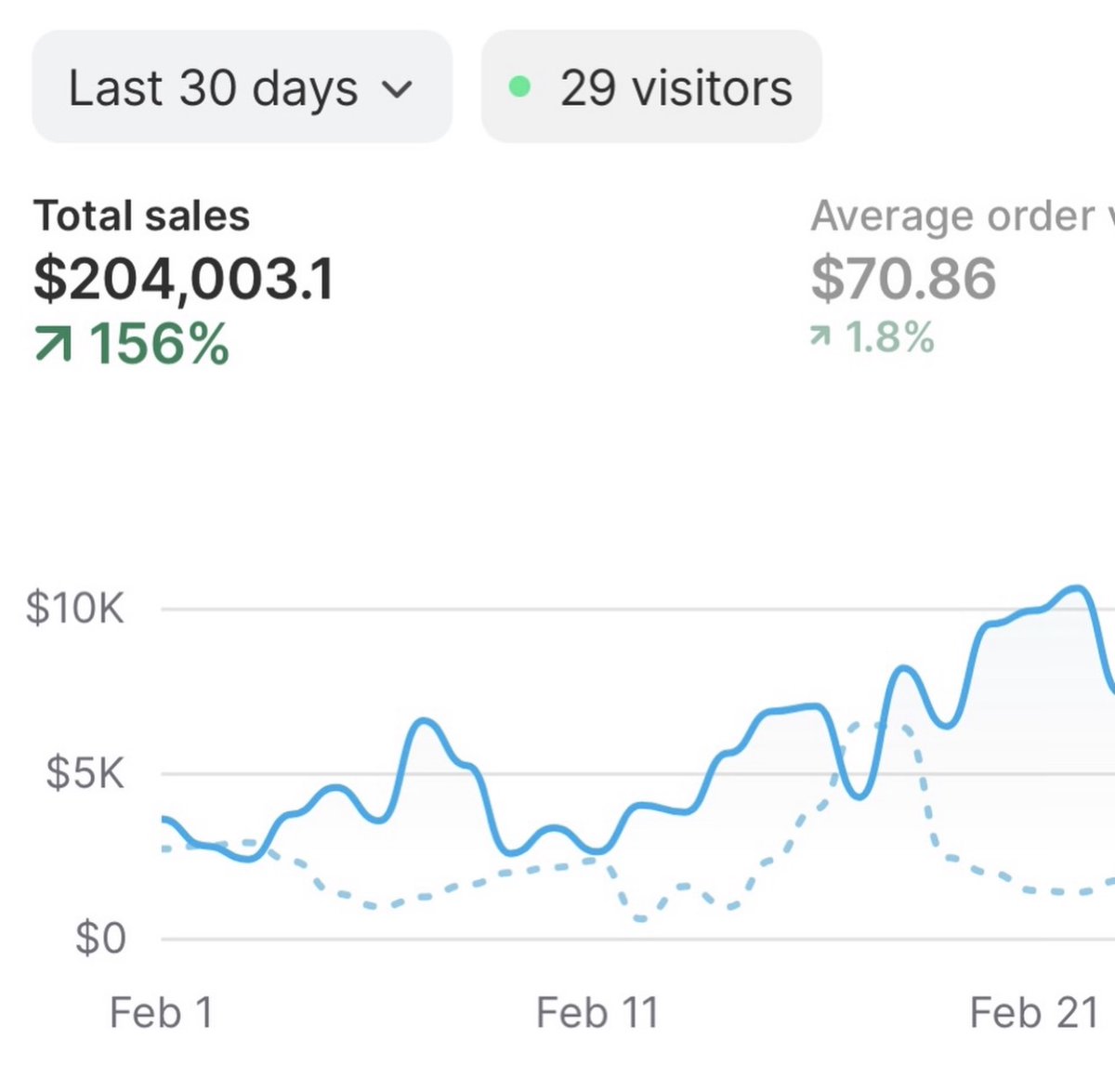
One store went from $16K in month 2 to $41K in month 3 and $91,340 in month 4. Net profit after product costs, fees and ads was $53,180.
The product did not suddenly become magical. The homepage did not win because it looked expensive. The store worked because Claude stopped being used as a writing tool and became the operating layer behind the business.
The mistake
Most people open Claude from scratch every time. One chat for product copy. One chat for ad hooks. One chat for customer emails. One chat for analytics.
Nothing connects, so nothing compounds.
That is the mistake.
A Shopify store is not a pile of outputs. It is the same decisions repeated every week: what to test, what to kill, what to fix, what to scale and what to stop trusting.
Random chats give you random answers. Saved loops give the store memory.
The new model runs on saved decisions
The store was not built around one magic prompt. It was built around six repeatable loops.
market_gap.prompt found the angle competitors were missing.
supplier_kill.prompt caught logistics problems before customers did.
page_truth.prompt turned the product page into objection handling instead of catalog copy.
creative_testing.prompt created ad angles before money was wasted on traffic.
retention_engine.prompt made the second order cheaper than the first.
sunday_operator.prompt read the store data every week and told the owner what to fix next.
That is the difference between using Claude as a writer and using Claude as the operator. A writer gives you copy. An operator keeps asking the same hard questions until the store stops leaking money.
Find pain before products
Most beginners start with the product.
That is already too late.
They find something trending, look at the top seller, copy the same page, use the same angle and launch a weaker version of a store that already exists.
Claude should not be used to copy the winner. It should be used to find the part of the market the winner is ignoring.
The input is simple: three competitor product pages, twenty bad reviews and the product you want to sell.
The output is not a description. The output is the gap.
The point is not to make Claude sound smart. The point is to make it kill weak ideas before Shopify takes your first dollar.
Most people only use AI after they already decided to build. This loop uses AI before the decision. That is why it saves money.
Kill bad suppliers before launch
Once the gap is clear, the next question is simple:
does this product actually deserve a store?
That is where most beginners get the order wrong.
They build the page, launch the ads, wait for sales, then discover the supplier is slow, the product page does not answer the real objection, the ad angle is weak, support is messy, and nobody knows what to fix next week.
Claude should catch those problems before they become expensive.
The first decision finds the market gap.
The next five decisions decide whether the store deserves more money.
Most Shopify stores do not die because the product is impossible to sell. They die because the supplier destroys trust after the sale.
Late delivery. Fake tracking. Bad packaging. Product quality that looked fine in the listing and terrible in the customer’s hand. By the time the owner sees the pattern, refunds are already open and Stripe is already nervous.
The supplier loop is simple: make Claude audit the supplier before the first order.
That prompt does not make the business more exciting. It makes the business harder to destroy.
Turn product pages into sales calls
After the supplier survives, the next leak is the product page.
Most pages sound like AliExpress rewritten in better English. “Premium quality.” “Perfect for everyone.” “Designed for comfort.” None of that answers the buyer’s real question.
The buyer wants to know: will this work for me, what could go wrong, why should I trust this store, and what am I not being told?
That is why page_truth.prompt does not write a normal product description. It turns the page into objection handling.
The best section is usually not what the product does. It is what the product does not do.
That line makes the page feel honest, and honest pages convert better than pages trying too hard.
Test creatives before buying attention
Once the page has an angle, the ad should not be one perfect script. That is another beginner mistake.
A good store does not test “an ad.” It tests angles.
One angle shows the pain. One shows the failed alternative. One shows the product in use. One answers the objection. One shows the result.
Claude’s job is to create those angles before ad spend starts.
This changes how ads are tested. The question stops being “is this product good?” The question becomes “which angle makes the buyer recognize their own problem fastest?”
That is a much better test.
Make support part of retention
The first sale is expensive because traffic costs money. The second sale is where the store starts breathing.
Most beginners ignore this. They spend all their energy getting the first order, then send the same default Shopify emails everyone else sends. That leaves money on the table.
retention_engine.prompt turns the customer journey into a simple sequence: confirm the order, set expectations, teach one useful thing, check in after delivery, ask for a review and introduce the next product only when it makes sense.
This is not the exciting part of Shopify. That is why it works.
Most competitors are still chasing the next click while the better store is quietly increasing the value of the buyers it already paid for.
Audit the store every Sunday
The final loop is the one that makes the system compound.
Every Sunday, the owner exports Shopify analytics and gives Claude the numbers. Not for motivation. For diagnosis.
Sessions. Conversion rate. Average order value. Cart abandonment. Returning visitors. Top products. Return rate. Ad spend. Revenue from paid traffic. ROAS.
Then Claude answers the same questions every week: where is the leak, what should scale, what should stop, is paid traffic finding buyers or just curious people, and what breaks first if nothing changes?
This is the loop most people skip because it feels boring. But this is where the compounding happens.
The store does not improve because the owner has a new idea every morning. It improves because the same five or six decisions get reviewed every week with better context.
That is the real Shopify + Claude system. Not a chatbot. Not a product description generator. A store operator made out of saved loops.
The math only works when the system repeats
By month 2, the store was doing $16K in revenue. By month 3, it reached $41K. By month 4, the dashboard showed $91,340, with $53,180 left after product costs, Shopify fees and ad spend.
That kind of jump makes people ask the wrong question.
They ask, “What product was it?”
The better question is, “What system kept improving the store every week?”
Because the product did not go from average to magical between month 2 and month 4. The operating layer got sharper. The supplier risk got lower. The page answered better objections. The ads tested clearer angles. The emails recovered more value from buyers who already paid. The Sunday audit stopped the owner from guessing what to fix next.
None of those changes looks dramatic alone. Together, they change the economics of the store.
A 1% better product page, a better opening shot, fewer refund issues, cleaner support replies and one useful weekly fix do not look like a $91K/month system when you see them separately.
But inside a Shopify store, small leaks are where the profit disappears.
The loops did not create the revenue by magic. They stopped the store from bleeding it out.
What Claude still cannot fix
The wrong lesson is that Claude makes Shopify easy.
It does not.
You still need a product people want, a supplier that can deliver, traffic that is not junk and margins that survive refunds, fees and ad spend.
Claude can help you see those things faster. It cannot make them true.
That is the difference between using AI as a shortcut and using it as an operating system.
A shortcut says: “write my page so this sells.”
An operating system says: “tell me if this should exist, where it will break, what buyers will doubt, what angle to test and what the numbers say after one week.”
The first one gives you a cleaner guess. The second one gives you a store that learns.
The next Shopify team will look like a folder of prompts
The old Shopify playbook was find a product, build a page, run ads and hope the numbers worked.
The new playbook is turning the store into repeatable decisions: what to test, what to kill, what to fix, what to scale and what to stop trusting.
Claude is useful when those decisions stop living in the owner’s head and start living in the system.
Shopify gives you the shelf. Claude gives you the operator. The store wins when the loop keeps improving.
Prompts
prompt
Act like a blunt ecommerce strategist.
Do not write copy yet.
I am testing whether this product deserves a store.
Inputs:
- Product idea: [paste the product you want to test]
- Competitor page 1: [paste the full product page or URL]
- Competitor page 2: [paste the full product page or URL]
- Competitor page 3: [paste the full product page or URL]
- Negative reviews: [paste 20 negative reviews from Amazon, AliExpress, TikTok Shop or competitor stores]
Give me:
1. The angle all competitors are using
2. The buyer pain they are all avoiding
3. The most repeated complaint in the reviews
4. The trust issue that would stop a new buyer
5. The one sentence my store should be built around
6. Whether I should build, sample, or skip

Rules:
- no generic advice
- no “improve branding”
- no “add better photos”
- no fake differentiation
- if the only angle is price, tell me to skip
prompt
Act like a blunt ecommerce operator.
I am giving you 7 days of Shopify data.
Do not motivate me.
Do not tell me this is normal.
Find what is broken.
Data:
- Sessions: [paste]
- Conversion rate: [paste]
- Average order value: [paste]
- Cart abandonment rate: [paste]
- Returning visitor rate: [paste]
- Top products by revenue: [paste]
- Product with highest return rate: [paste]
- Traffic sources: [paste]
- Ad spend: [paste]
- Revenue from paid traffic: [paste]
- ROAS: [paste]
- Email revenue: [paste if available]

Answer:
1. What is the biggest leak in the store right now?
2. Which product should get more attention this week?
3. Which product should be paused or watched?
4. Is traffic quality good, or am I buying browsers?
5. What is the fastest change I can make in 4 hours?
6. What gets worse if I change nothing for 14 days?

One paragraph per answer.
Be specific.
Use the numbers.
If something is stupid, say it directly.
prompt
Act like a TikTok and Reels creative strategist for a Shopify store.

Product: [paste product]
Customer: [paste target customer]
Market gap: [paste]
Main objection: [paste]
Product page angle: [paste]

Create 5 ad concepts.
Each concept must include:
- Opening shot
- First spoken line
- What happens in the first 3 seconds
- Main emotional trigger
- Product demo moment
- Final line before CTA

The 5 angles must be different:
1. Pain angle
2. Failed alternative angle
3. Product demo angle
4. Objection angle
5. Result angle

Rules:
- no polished brand ad
- no “game changer”
- no “you need this”
- no fake customer story
- make it feel like a real phone video, not a commercial
prompt
Act like a conversion-focused Shopify editor.
Do not make the product sound better than it is.
I will give you:
- Product: [paste product]
- Market gap: [paste from market_gap.prompt]
- Main buyer fear: [paste]
- Top negative review patterns: [paste]
- Product strengths: [paste]
- Product limitations: [paste]

Build the product page around trust.

Output:
1. Opening line:
The exact pain this product solves in plain language.
2. Who this is for:
One short paragraph.
3. Who this is not for:
One short paragraph that builds trust.
4. Three benefit bullets:
Outcome-focused, not feature-focused.
5. Objection section:
Answer the 3 doubts most likely to stop checkout.
6. FAQ:
Five questions a skeptical buyer would ask before paying.
Rules:
- no “premium quality”
- no fake urgency
- no fake reviews
- no corporate language
- no pretending the product is perfect
prompt
Act like the retention operator for my Shopify store.

Product bought: [paste]
Customer type: [paste]
Shipping time: [paste]
Related product: [paste if any]
Brand tone: human, direct, not corporate

Write a 5-message post-purchase sequence.
Message 1: immediately after purchase
Confirm the order and set realistic shipping expectations.
Message 2: day 3
Give one useful tip related to the product. No selling.
Message 3: day after delivery
Check in with one simple question.
Message 4: day 14
Introduce one related product only if it genuinely pairs with the first purchase.
Message 5: day 30
Ask for a review and tell the customer what kind of detail helps.
Rules:
- under 100 words each
- no fake urgency
- no “we value your business”
- no corporate apology language
- no discount unless I provide one
prompt
Act like a paranoid ecommerce operator.
I am checking this supplier before launching a Shopify store.
Inputs:
- Product: [paste product]
- Supplier page: [paste supplier page or URL]
- Listed shipping time: [paste]
- Supplier rating: [paste]
- Recent reviews: [paste 15 recent reviews]
- Negative reviews: [paste 5-10 critical reviews]
- Product cost: [paste]
- Expected retail price: [paste]

Find:
1. Any gap between listed shipping time and real customer reports
2. Repeated quality complaints
3. Refund or return risk
4. Signs the reviews are fake or too clean
5. Packaging or damage risk
6. Whether this supplier can handle scale

Give me a verdict:
GO = safe enough to test
SAMPLE = order one first
SKIP = do not launch with this supplier
Be direct. If the supplier can kill the store later, say SKIP.
Related articles
One Shopify store hit $91,340/month by using Claude as the operator, not the writer.
Shopify + Claude is not about product descriptions.
how to turn claude + higgsfield MCP into a $10k+/day AI creative MACHINE
the creative production workflow i'm about to break down produces 40+ ad variants per week for my supplement brand.

ChatGPT vs Claude: Which One Actually Makes You Money
$20 a month, either one. The return is nowhere near the same, and it depends entirely on what you're building.