How to Hit 6 Figures MRR With a Consumer App in 6 Months. No Ads Required.

i've studied over 60 apps that scaled past $100K MRR using creator content instead of paid acquisition.
most of them look nothing alike. different categories. different budgets. but every single one proved the same thing: you don't need ads to build a real business on mobile.
here are 5 of the most interesting ones, broken down by exactly what they did, what they spent, and what happened.
- Gleam: Dead App to $100K MRR in 30 Days
gleam is a social skills app. think "duolingo for conversations." before their UGC campaign, they had 30K downloads and were basically dead.
then they did something most agencies would call insane: they hired 7 creators and told them to make 10-minute tiktok videos (u can check an example below)
not 30-second hooks. not 60-second tutorials. 10-minute storytime videos where the creator tells a personal story about being socially awkward, and the app appears as the resolution, as the actual answer to their problem.
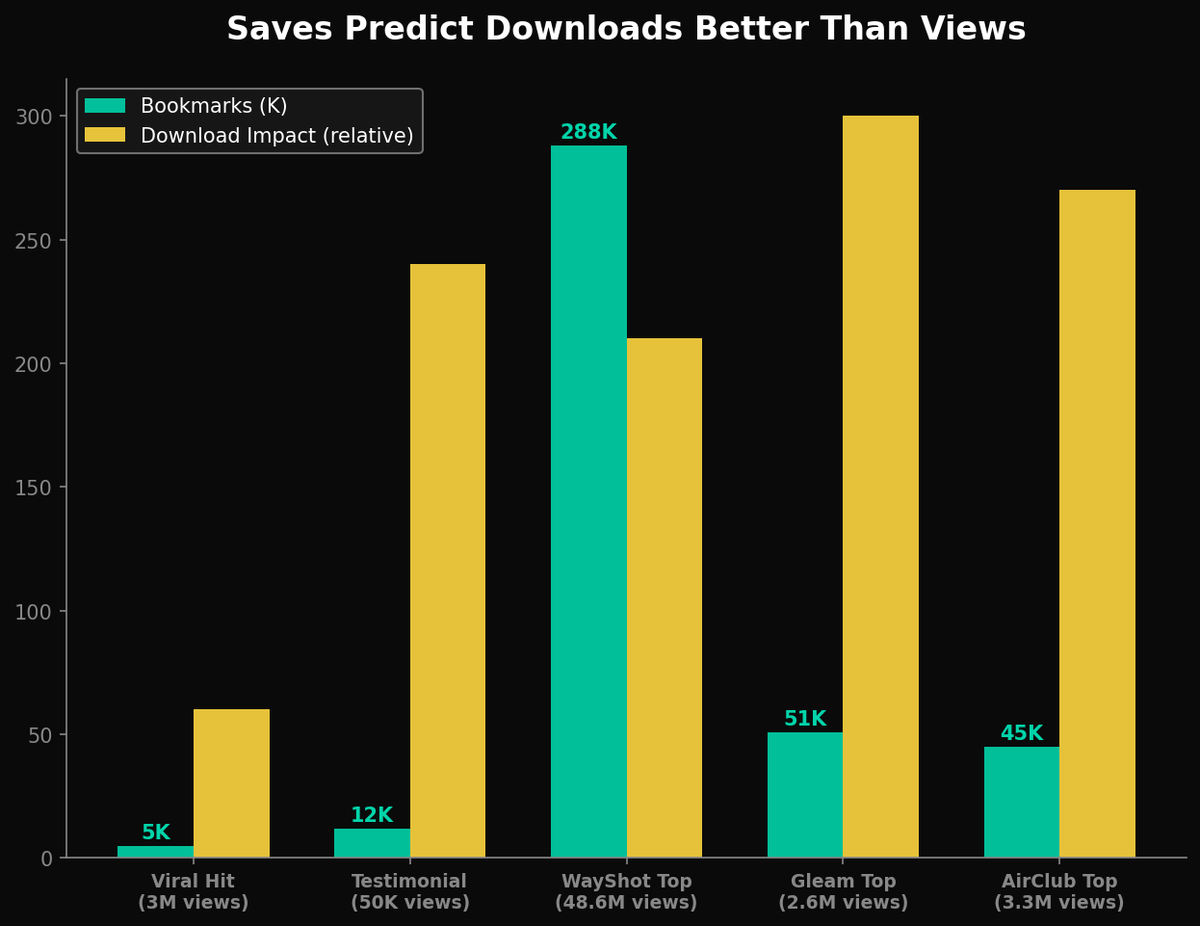
the lead creator, @squashwinz (255K followers), posted a video called "the quiet friend." it hit 2.6 million views and 51,000 bookmarks.
within 30 days, gleam went from 30K to 70K+ downloads. MRR crossed $100K from essentially zero.
the counterintuitive part: 10-minute videos on tiktok. everyone says short content wins. gleam proved that when the story is good enough, people will watch anything. the algorithm doesn't care about length. it cares about retention. and a good story retains better than a quick hook.
what they spent: 7 creators, standard micro-creator rates ($15-20/video).
what they got: $100K+ MRR. 40K+ new downloads. a 20x return in month one.
- WayShot: 8 Accounts to $100K MRR and 500K Downloads/Month
wayshot is a photo editing app. 9 months old at the time of this analysis.
their entire operation runs on 8 creator accounts. that's it. no massive creator army. no 200-account network. 8 accounts posting consistently.

but their format strategy is what makes them interesting. they run a 3-format system:
format 1 (organic reach): relatable content that happens to show the app.
their top video hit 48.6 million views, 288K bookmarks, and 83K comments. the hook was "that friend who thinks everything is aesthetic." it's not even about the app. it's about a personality type. the app just appears naturally.
format 2 (product awareness): before/after comparisons.
but they flip the order. they show the "after" first (the beautiful photo), then the "before" (the original). this creates curiosity because the viewer wants to know how the transformation happened. peak performance: 7.5 million views, 75K bookmarks.
format 3 (aspirational saves): videos that make people save the post.
4 videos with 2M+ views each in april 2026 alone.
the insight here is the mix. format 1 gets them reach. format 2 teaches people what the app does. format 3 drives downloads because the viewer needs the app to get the result.
total views across 8 accounts: 150 million.
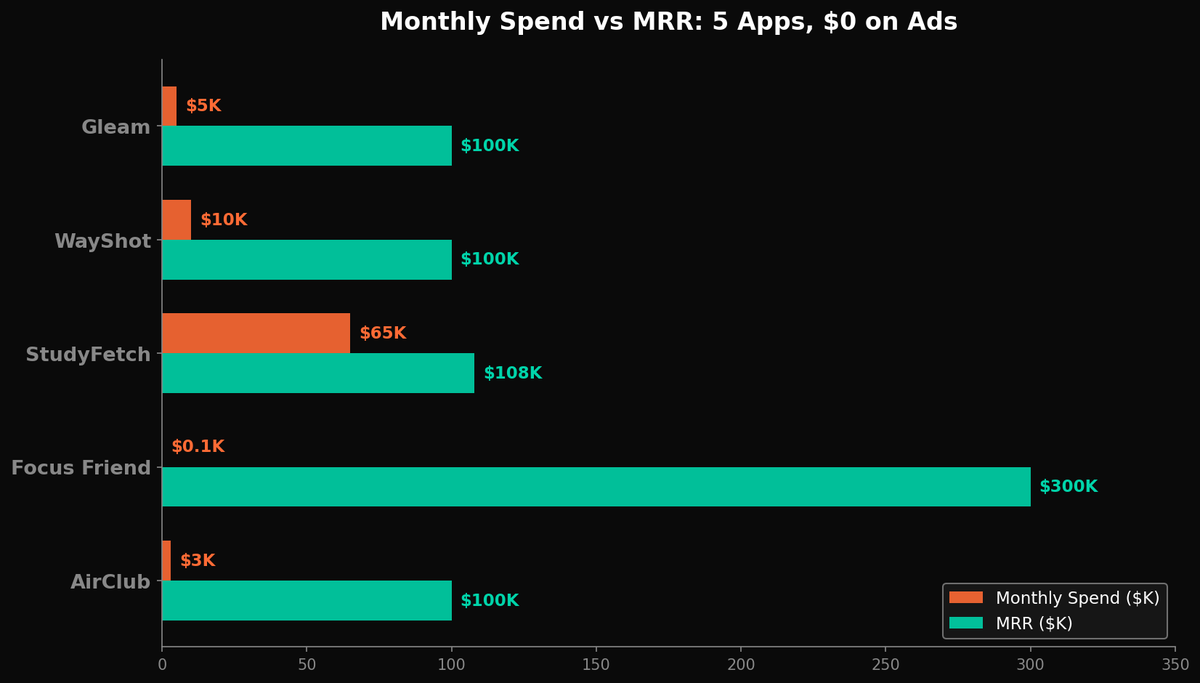
what they spent: 8 creators at micro rates. probably under $10K/month total.
what they got: $100K MRR, 500K+ downloads/month, and a format system they can run indefinitely.
- StudyFetch: 225 Accounts, 150 Videos/Day, Approaching 1 Billion Views
studyfetch is the opposite of wayshot. where wayshot runs lean, studyfetch runs an army.
they're an AI study app (think flashcard generator on steroids). founded in january 2023. by mid-2026, they had:
· 995 million total views (approaching 1 billion)
· 8.3 million saves
· 1.9 million shares
· 225 active accounts (100+ on tiktok, 50+ on instagram, 1 youtube)
· 150+ videos published per day
· $108K MRR
their model is the ambassador program. each creator runs 2 accounts. they're not just posting for studyfetch, they ARE studyfetch on their platform.
their top ambassadors tell the story:
· studyfetchjeanne: 50M+ views
· chady: 35M+ views
· studyfetchlauren: 28M+ views
the format that works best for them is the "lecture-to-summary transformation." a creator films themselves looking overwhelmed by a lecture, then shows the app converting their notes into a study guide in seconds. it's a before/after, but the before is an emotion (stress) and the after is a result (clean summary).
this only works because they have 225 accounts creating variations. most individual videos get modest views. but when you post 150 videos per day, the hits find themselves. it's pure volume strategy, and the math works because their cost per video is minimal.
what they spent: base pay for 100+ creators at $15-20/video. total monthly spend probably $50-80K.
what they got: nearly 1 billion views, $108K MRR, and a machine that compounds every month.
- Focus Friend: 20 Pieces of Content to #1 in the App Store
this one breaks every rule.
focus friend is a pomodoro timer app built by hank green (yes, that hank green. 12M+ followers across platforms). it launched and hit #1 in the app store within 72 hours.

the entire launch consisted of 20 pieces of content. that's not a typo. 20 total.
· 1 youtube video
· 5 youtube shorts
· 5 instagram reels
· 9 tiktoks
his first tiktok hit 2.3 million views. his youtube shorts combined for 5.8 million views.
but the real magic wasn't the content. it was what happened after.
the app has a gamified bean character. users loved it. they started making their own content about the bean. organic UGC flew without any creator program, any brief, any payment. the product itself was so share-worthy that the content flywheel spun on its own.
the viral comment that tells the whole story: "i didn't have to make an account to start." it got 20,500 likes. people were shocked that an app just... worked. no friction. no signup wall. just value.
focus friend hit $300K MRR.
now, most founders reading this will say "i'm not hank green." true. but the lesson isn't about having 12M followers. the lesson is:
a great product creates its own content (the bean became a meme)
removing friction is itself a marketing strategy (no account required became the viral moment)
20 pieces of content can outperform 20,000 if the product is right
price: $1.99/month or $29.99 lifetime. low price, high volume. the content did the rest.
- AirClub: Reading Flight Deals Out Loud to $100K MRR

this is my favorite because it's the most boring.
airclub is a flight deals app. they hit $100K+ MRR in 10 months. their tiktok has 24 million views across 257 days.
their top video: 3.3 million views. the format? someone literally reads flight deals out loud. that's it. no transitions. no effects. no trending audio. a person looks at a screen and reads "new york to paris, $287 round trip, travel tuesday deal."
it sounds like it shouldn't work. but it works because:
bookmarkable content.
people save flight deal videos to check later. saves are the highest-weighted signal in the tiktok algorithm. when a video gets saved at high rates, the algorithm pushes it to more people who are likely to save it. it's a compounding loop.
different creators for different demographics.
they don't use one creator for everyone. they match creators to the traveler persona. a 22-year-old for backpacker deals. a 35-year-old for family vacation deals. each creator's audience self-selects into the right segment.
first-mover advantage in format.
nobody was doing content-led flight deals growth when airclub started. by the time competitors showed up, airclub had 10 months of algorithm training and audience trust.
what they spent: a handful of creators reading deals. total cost probably under $3K/month.
what they got: $100K+ MRR in 10 months, a format that's almost impossible to burn out (there are always new deals), and a moat built on consistency.
The Pattern Across All 5
every one of these apps is different. a social skills app. a photo editor. a study tool. a timer. a flight deals aggregator.
but they share 4 things:
- they found one format that worked and ran it into the ground.
gleam found storytime. wayshot found before/after. studyfetch found lecture transformations. focus friend found founder-led product demos. airclub found deal-reading. none of them tried to do 10 formats at once. they picked one, proved it, then scaled it.
- they paid less than you'd expect.
gleam spent under $5K. airclub spends under $3K/month. even studyfetch, with 225 accounts, runs on micro-creator rates. the total spend across all 5 is probably less than what one app spends on meta ads in a single month.
- they optimized for saves, not views.
the videos that drove the most downloads weren't always the ones with the most views. they were the ones with the most bookmarks. saves signal intent. a person who saves a video about your app is 10x more likely to download it than someone who liked it and scrolled past.
- the product did half the work.
gleam's app was the story resolution. wayshot's results made people want the app. focus friend's bean became a meme. airclub's deals were inherently shareable. when the product is interesting, the content almost writes itself. when the product isn't interesting, no amount of content strategy will save it.
The Math That Should Make You Rethink Your Budget
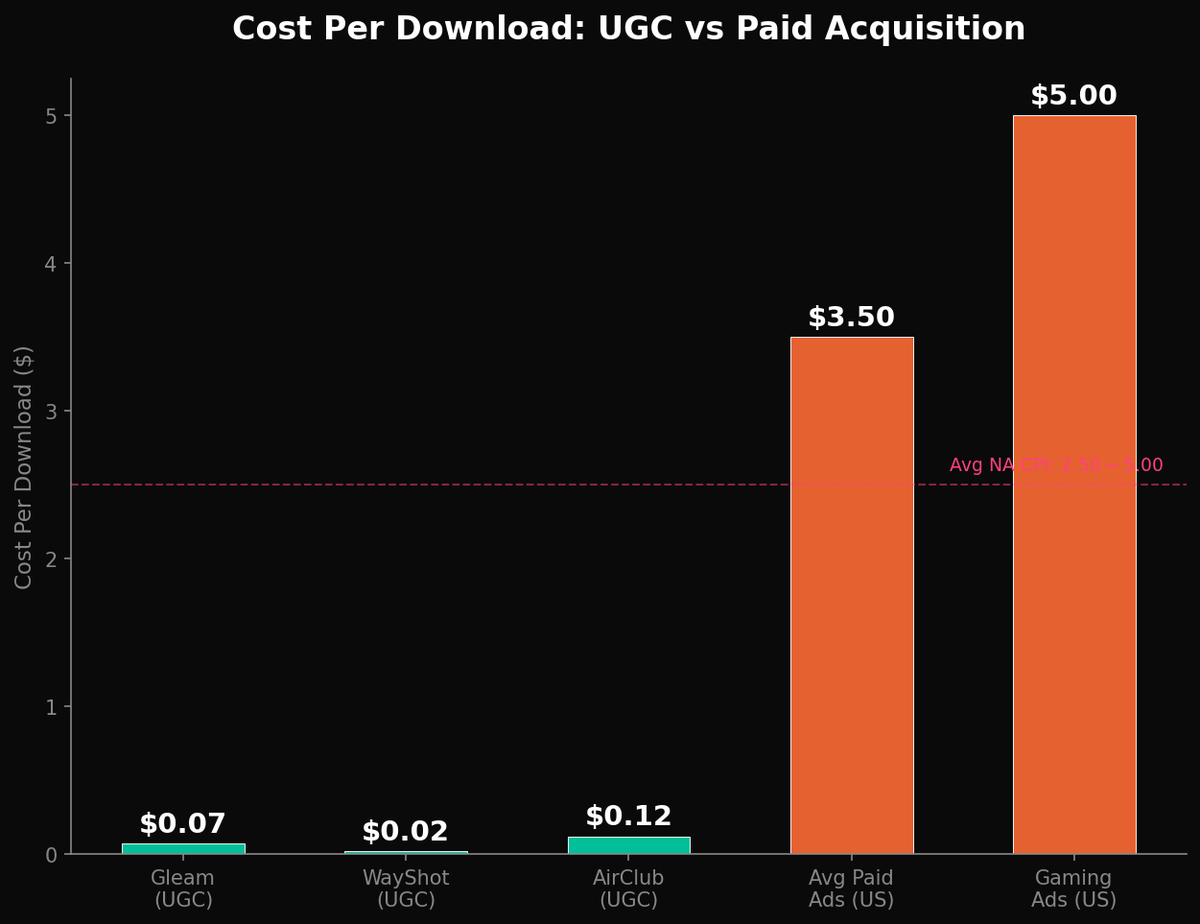
compare that to paid acquisition where the average CPI in north america is now $2.50-5.00 and rising 30% year over year.
one approach bleeds money every month. the other compounds.
i've worked with 40+ apps like these. the ones that win aren't the ones with the biggest budgets. they're the ones that find one format, one audience, and one creator type that clicks, and then they do it 1,000 times.
the playbook isn't complicated. it's just not what most people expect.
if you're an app founder spending more on ads than on creators, the math is working against you. we build these systems for a living. DM me if you want to see what it looks like for your app.

Related articles

I scaled My App to 15K/Month in 2 Months (FULL GUIDE)
My apps made 18K this month at 18 years old....

How We Scaled RIZZ app to $400K/Month (Full Playbook)
it wasn't the product. it was a machine we built underneath it, and once you see how it works you'll spot it all over your feed.

The Lazy Way to Make $10K+/Month With Mobile Apps (The Complete Guide)
In this article, I’m going to break down the lazy way to scale your app to $10K/month.