How We Scaled RIZZ app to $400K/Month (Full Playbook)

it wasn't the product. it was a machine we built underneath it, and once you see how it works you'll spot it all over your feed.
the dating app market is where startups die. tinder owns the top, every other app is a clone of a clone, and paid ads eat you alive before you ever hit ten thousand installs.
RIZZ came out of that graveyard doing $400k a month, bootstrapped, with almost no ad spend.
this is the full playbook: the format that printed installs, the pay structure that turned creators into a machine, the quality control nobody talks about, and how the same engine runs for any app now. real numbers throughout.
bookmark this and come back anytime. the next time you launch an app, run this playbook before you spend a dollar on ads.
it starts with a format, not an app
the first thing that made it work is the thing most founders never do: nobody downloads an app because you told them to. they download it because they watched something they couldn't look away from.
so instead of making ads, the play was to hijack a format that was already winning.
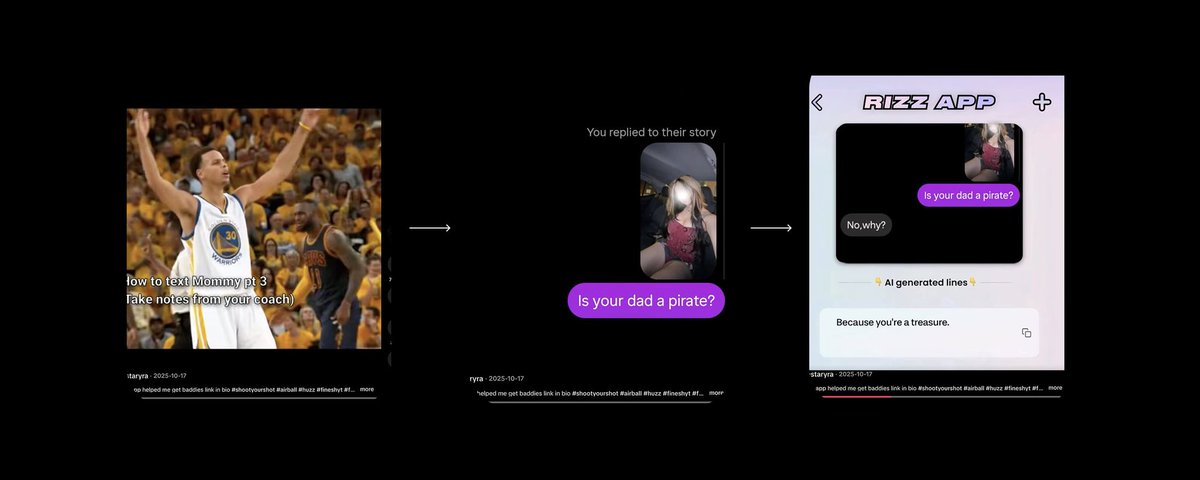
mid 2023, tiktok was drowning in texting-story videos.
so RIZZ was slipped inside it. the guy pulls out the app, and the perfect reply appears on screen.
the app was never advertised. the app was the punchline. you don't scroll past a punchline. you watch it land, and then you go get the thing that made it work.
then came the creator problem
a format is nothing without people posting it, and the people posting were quietly starving.
tiktok's creator rewards program is a lottery. it lands around twenty cents per thousand views on a good month, and it swings hard whenever the platform feels like it. you could go viral, a full million views, and clear a couple hundred bucks. no floor, no consistency, no way to build a month around it.
so here was the move nobody else was making back then: pay creators directly, per view, and not by a little.
one to two dollars per thousand views. same million-view video: two hundred dollars from tiktok, or a thousand to two thousand from them. five to ten times the money for the exact same work, and it landed on a schedule you could actually count on.
that changed how creators behaved. it stopped being a gamble and became a job. they sharpened hooks, tested scripts, treated it like a business, because for the first time it paid like one.

then production became the bottleneck
creators had ideas faster than they could edit them. every video meant bubbles, animation, captions, timing, hours of it.
so that got solved too. internal tools that take a script and hand back a finished video in seconds.
and that's when it went from a growth tactic to a flood.
300,000+ videos. 5 billion+ views. 130,000+ posts on one branded hashtag. all bootstrapped, all feeding one app.
but volume alone is a trap
a format can pull millions of views and still convert nobody, because the product is sitting on top of the content instead of inside it. or it converts but never travels, because the integration is so heavy it reads as an ad.
so every format got tested cold before it got money: run it small, track revenue per million views, scale only what clears the bar. no feelings, just the number.
and the boring part is what actually held it together

nobody writes threads about verification, and it's the entire difference between real numbers and fake ones.
on one campaign, zero dollars got paid out on 44 million views, because they were botted or broke the rules. every submission runs bot detection, then a human, then an AI that checks the video frame by frame against the brief.
then came the realization that changed everything
at some point it stopped looking like a growth hack for one app and started looking like infrastructure.
founders with their own apps asked to borrow it. we let them. same creators, different products, and it worked every time.
so we stopped keeping it private and opened it up. the whole engine became a platform called AffiliateNetwork, where any brand can plug in and run the exact machine that built RIZZ.
that was the moment RIZZ went from being the whole company to being client number one. Kalshi, Polymarket and PumpFun lined up behind it. same creators, same verification, different products.
RIZZ was never the point. it was the proof.
this is one of many apps we run exactly like this. i break down a new one every week → follow @twoclipping for more.
2026: the creators don't even have to be real anymore
the engine ran on human faceless creators. now it runs on AI ones too.
a human creator recently did 18.6M views on a single video for another client of ours. we handed the same format to AI creators, and it worked just as well.
so here's how you run it for your own app
find a format in your niche that's already printing. one creator stacking half a million likes on a repeatable structure is your signal.
get your product inside it, as the punchline, never the pitch.
test it small, track revenue per million views, scale only what clears.
then run it through campaigns instead of chasing creators one by one. pay per view, verify everything, watch conversion by the hour.
that last part, the recruiting and the verifying and the paying, is the part that used to be a full-time job. that's the part a platform does for you now.

RIZZ was the first app on this engine. dozens have followed. the same machine runs for any app or brand that wants it.
if you want it pointed at yours:
launch your campaign → link.affiliatenetwork.com/two
the graveyard is full of better products. it has never once been full of better distribution.

Links
Related articles

I scaled My App to 15K/Month in 2 Months (FULL GUIDE)
My apps made 18K this month at 18 years old....

How to Hit 6 Figures MRR With a Consumer App in 6 Months. No Ads Required.
i've studied over 60 apps that scaled past $100K MRR using creator content instead of paid acquisition.

The Lazy Way to Make $10K+/Month With Mobile Apps (The Complete Guide)
In this article, I’m going to break down the lazy way to scale your app to $10K/month.