How to Turn One TikTok Video Into a Global Income Stream

You spend hours researching an AI tool, writing a script, recording the video, and editing it into something genuinely useful.
Then you post it once in English and start from zero on the next idea.
That is the usual creator loop: every new market means another script, another shoot, another edit, and another chance to make money from scratch.
This article is about breaking that loop.
I am going to show you how one English AI tutorial can become separate localized versions for Latin America, Brazil, and other language markets -without hiring a translation team or rebuilding every video from zero.
The goal is not vague “global reach.” It is to give one strong piece of work more than one chance to find an audience, an affiliate sale, a sponsorship, a creator-program payout, or a digital-product customer.
Here is the practical upside:
-
the same research can serve several audiences;
-
one production workflow can build several language-specific accounts;
-
you can test a market before paying for a full local team;
-
one video can become the starting point for several revenue paths instead of dying as a one-day post.
This is not a guide to adding subtitles to an English video.
It is a system for rebuilding the script, examples, voice, captions, and packaging until each version feels native enough that someone in the new market will actually watch it.
Why this window exists
- Translation quality crossed a practical threshold
Machine translation used to be the obvious weak point. It was too literal, too formal, and too bad at jokes, rhythm, and cultural references.
Current models are much better when you give them a real brief: who the audience is, which country they live in, how they speak, and what needs to change rather than merely translate.
That does not mean every output is publish-ready. It means a solo creator can now get a strong first draft, then spend their time on the parts that actually need judgment.
- The opportunity is not “less competition” in every niche
Spanish, Portuguese, and Arabic are huge language markets, but audience size alone is not a strategy.

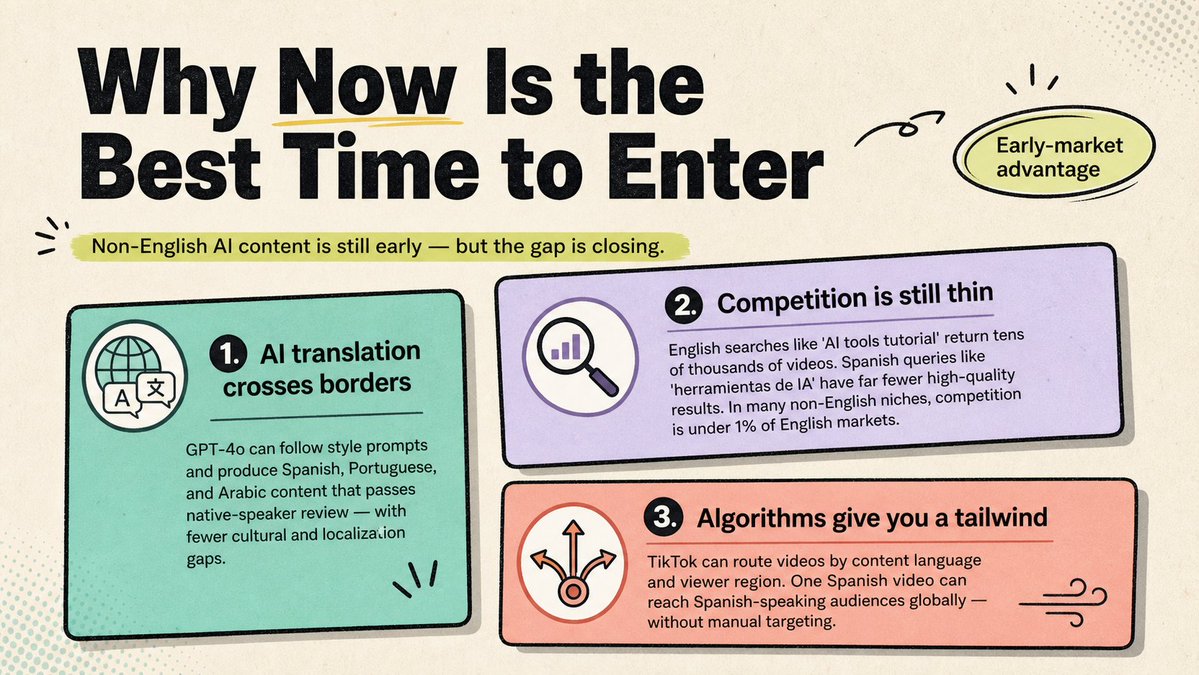
The real opportunity is that many AI tutorials outside English are still generic, under-explained, or obviously translated. A creator who makes useful material feel native can stand out quickly.
- Language gives both viewers and platforms a clearer signal
TikTok says recommendations can be influenced by user interactions, content information, and user information such as language preference and location. For most people, interaction signals - including watch time - matter more than those settings.
TikTok's explanation of recommendations is worth reading before you build a strategy around any one setting.
The practical takeaway is simple: a properly localized video gives viewers an immediate reason to stay. The language, examples, captions, and pacing all tell them, “this was made for me.”
Pick a market, not just a language
Do not launch four accounts because a diagram says you can. Pick one market first, learn what resonates, then expand.
Spanish: the easiest first test
-
More than 500 million people speak Spanish across many countries.
-
Mexico and Colombia are a useful starting cluster for Latin American Spanish, but the same wording will not land identically everywhere.
-
The audience is large enough that you can find a real niche inside AI tools, productivity, automation, coding, or creator workflows.
Portuguese: Brazil is its own market
-
Brazil is large enough to justify its own content strategy instead of treating Portuguese as an afterthought.
-
Local references and a natural Brazilian voice matter more than a perfect literal translation.
-
It is a strong second market after you have a repeatable Spanish workflow.
Arabic: higher nuance, more moving parts
-
The Middle East and North Africa are not one uniform audience.
-
Right-to-left text and regional differences add production complexity.
-
This is better as a later expansion once the localization workflow is working.
For a first experiment, I would start with Latin American Spanish or Brazilian Portuguese. The point is not to cover the world on day one. The point is to build one version that feels real.
The 1-to-4 workflow: from one English video to localized versions


Step 1: Start with content that can survive translation
The best starting point is your own English content library: AI tool tutorials, productivity workflows, coding explainers, technology news, or evergreen guides.
Good content for localization:
-
AI tool tutorials, because the tool is usually global.
-
Productivity and workflow content, because the underlying problem is universal.
-
Technology explainers that give people a useful frame, not just news.
-
Educational content with a clear before-and-after payoff.
Bad content for localization:
-
English-language inside jokes that have no local equivalent.
-
Videos whose entire payoff depends on a pun or a meme nobody in the new market knows.
-
Screens full of untranslated UI or text that viewers cannot read.
-
Someone else's video that you do not own or have permission to adapt.
That last point matters. Changing the voice and subtitles on another person's video is not a localization strategy. Start with content you created, commissioned, or licensed.
Step 2: Ask AI to localize, not translate
The difference between “translate this into Spanish” and “rewrite this for young viewers in Mexico and Colombia” is the difference between a video that sounds imported and one that has a chance of being watched.
Use a prompt like this:
Requirements:
-
Keep the original information density and pace.
-
Create a clear hook in the first three seconds.
-
Use conversational language, not formal written Spanish.
-
Replace US-specific examples, brands, or cultural references with locally familiar equivalents when necessary.


-
Preserve any technical terms that are commonly used in English, but explain them if a new viewer needs context.
-
End with a question or observation that local viewers will have an opinion about.
Three things make this work:
-
Name a real audience and region. “Spanish speakers” is too broad.
-
Ask for a rewrite. A literal translation is the wrong goal.
-
Make the model handle cultural gaps, then read the result like a skeptical local viewer.
Step 3: Choose the voice
The voice is where a local version either starts to feel real or immediately falls apart.
Option A: ElevenLabs voiceover
ElevenLabs can generate speech in multiple languages and is a practical way to test localized versions without booking a voice actor for every video. Its plans and usage limits change, so check the current pricing before scaling.
Option B: Google Cloud Text-to-Speech
Google's text-to-speech tools are a lower-cost way to test the workflow. The voice may be less expressive, but it is enough to find out whether the topic and language market are working.
Option C: A native voice actor
For your strongest videos, a native voice actor is still the highest-quality option. Search marketplaces such as Fiverr for Spanish voice actor or Portuguese voice over.
Use AI voice to test. Use a human voice when the format proves it deserves more production.
Step 4: Localize the visuals, not only the audio
Subtitles are not a finishing touch. They are part of the product.
CapCut can help create and time multilingual captions, but you still need to review them. Spanish and Portuguese often take more characters than English, so text that looked clean in the original may cover the video in the localized version.
Check every visible layer:
-
Subtitle size and line breaks.
-
Title cards and thumbnails.


-
Screenshots with English-only labels.
-
Currency, dates, examples, and cultural references.
-
Any sentence that assumes the viewer lives in the US.
If the visuals keep saying “this was made for Americans,” the new voice will not fix it.
Step 5: Publish like you are testing a market, not gaming a setting
Use one language per account so the audience expectation is obvious. Write the bio in that language, keep captions and replies in that language, and let the account build a coherent identity.
Start by testing windows when the target market is likely to be awake and using TikTok. These are starting hypotheses, not universal rules:
Do not use English hashtags by default. Use language-specific tags that actually describe the video:
-
Spanish: #herramientasIA #productividad #tecnología
-
Portuguese: #ferramentasIA #produtividade #tecnologia
Then watch the signals that matter: completion rate, rewatches, saves, shares, comments, and whether people keep asking for a version in their language. Those are more useful than obsessing over a perfect posting time.
Step 6: Build a content matrix after one version works
The efficient model is not “make an English video, then translate it once.” It is one strong source video rebuilt for several markets.
One production process can reach several markets. But the marginal cost is only low if you do not cut the part that makes the content feel local.
Four ways the model can make money
There are four common routes. Which one matters depends on your market, audience, and eligibility.
- Creator monetization programs
TikTok's creator programs vary by country, account eligibility, and policy. Treat any payout number as temporary and check the current rules inside your account before building a business model around it.
- TikTok Shop and affiliate offers
If TikTok Shop is available in your market, a localized account can recommend relevant tools, products, or creator gear and earn a commission on qualified sales.
- Brand partnerships

Once an account reaches a meaningful audience, local brands may pay for native-language integrations. A real local audience is more valuable than a large account full of viewers who do not trust the language.
- Digital products
AI guides, Notion templates, paid tutorials, prompt packs, and digital downloads can work when they solve the same problem your short-form content already demonstrates.
What the experiment actually costs
This is a simple starting estimate, not a permanent price sheet. Pricing changes as tools update their plans.
Four language versions can therefore cost roughly $4-32 before any human review, voice talent, or paid distribution.
Compared with a full translation-and-voiceover team, that is still a meaningful reduction. But the real advantage is speed: you can test a market before committing to a larger production setup.
The part AI cannot do for you
Three years ago, multilingual video required a translation team, several native voice actors, and local operators in each market.
Now one creator can build a first test with a script, a model, an AI voice tool, and an editor.
That lower barrier is real.
The mistake is thinking it removes the need to understand people.
The creator who wins will not be the one who presses “translate” the fastest. It will be the one who notices where the original joke fails, where the subtitle becomes unreadable, where a local viewer needs a different example, and where the content starts to feel like it was actually made for them.
One video is not automatically an income stream. But a repeatable system that turns one useful idea into several native-feeling versions gives that idea more markets, more ways to earn, and a longer life than a single post in one language.
Start with one language. Make one version that feels native. Find one monetization path that fits the audience. Then turn that into a system.
Follow, like and bookmark pls if it was useful for you 👉👈🥹
Prompts
One original English video script
        ↓
Localized versions:
├── English version for the US, UK, and Australia
├── Latin American Spanish version
├── Brazilian Portuguese version
└── Arabic version for a defined MENA audience, once the workflow is mature
        ↓
Reuse the core visual assets where they still make sense
        ↓
Generate or record voiceover for each language
        ↓
Localize captions, title cards, and examples
        ↓
Publish through separate language-specific accounts
You are a native Spanish-speaking TikTok creator.
Your audience is 18-35-year-old viewers in Mexico and Colombia who are interested in AI tools and productivity.
Rewrite the following English video script in natural Latin American Spanish.
Do not translate literally. Use the language, rhythm, and examples that local creators would actually use.Article tables:
| Item | Typical cost per localized video |
|---|---|
| AI script localization | roughly $0.50-1.00 in usage cost |
| AI voiceover | roughly $0.50-2.00 |
| Editing in CapCut | $0 if you edit it yourself |
| Visual assets, generated or reused | $0-5.00 |
| Total | roughly $1-8.00 |
| Target market | Test first, local time |
|---|---|
| Mexico | 7-9 AM and 7-10 PM |
| Brazil | 7-9 AM and 8-11 PM |
| Colombia | 7-9 AM and 7-10 PM |
Links
Related articles

The Truth About AI Consulting (After 87 Clients and 4 Years)
Over the last 4 years I've spoken with thousands of business owners about AI and automation.

I Brutally Modified My Front-End Design Skill ~ Now My UIs Don’t Look Like AI Crap
To create a custom Claude skill, navigate to Customize > Skills in your Claude interface, click the + button, and select + Create skill
I replaced $1000+/year in subscriptions with these 50 free GitHub tools
Every month, you pay for software that you could be running for free