The Agent Economy Hasn’t Picked a Winner Yet
Every major platform shift has begun with small behavioral changes that seem obvious in hindsight.
The first internet made information searchable. The mobile internet made everything real-time. Crypto made value programmable, and now AI agents raise the next question: what happens when software goes beyond just searching, writing, or recommending and focuses on transactional activity?
That’s the part people are still underestimating.
An Agent that can book flights, buy data, pay for compute, route a payment, or execute a trade can’t stop to have a human enter a credit card. It can’t wait for billing approval every time it needs a premium API. It can’t coordinate with another agent if the settlement layer is still built around forms, invoices, subscriptions, and delayed reconciliation.
At a small scale, this looks like a UX problem. At a large scale, it’s really an infrastructure problem.
If agents are going to operate freely across the internet, they’ll need a way to pay, settle, verify, and coordinate without dragging humans back into every step of the workflow.
This is why x402 has become one of the most important developments in crypto this year.
The First Breakthrough Was Payments
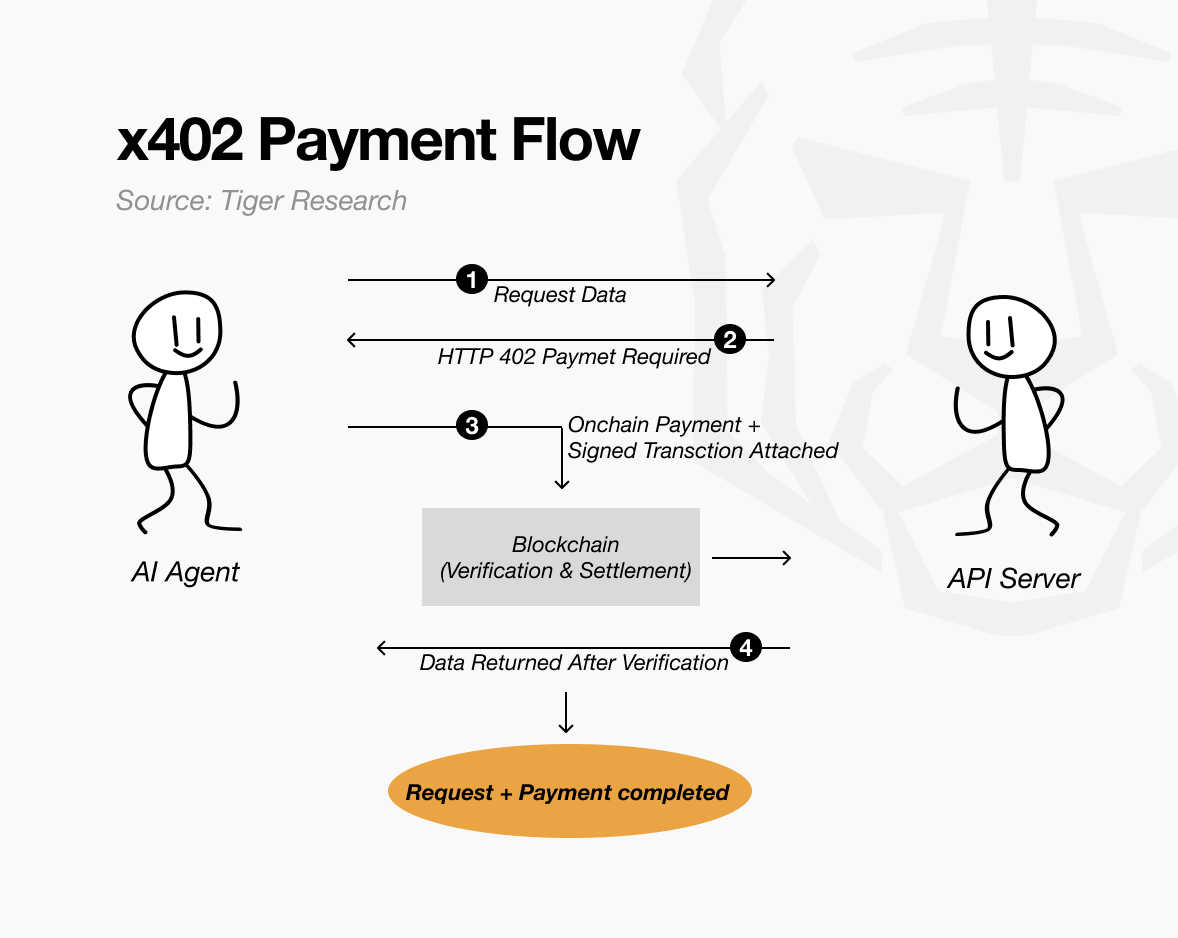
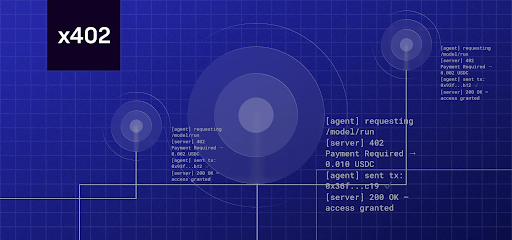
x402 revived the old HTTP 402 “Payment Required” status code and turned it into something usable for machine-native payments. A server requests payment, the agent pays in stablecoins, and the workflow continues, completely cutting humans out of the loop.
It sounds simple, but the implication is much larger. For the first time, software can start paying for resources the same way it already requests data: instantly, programmatically, and over internet-native rails.
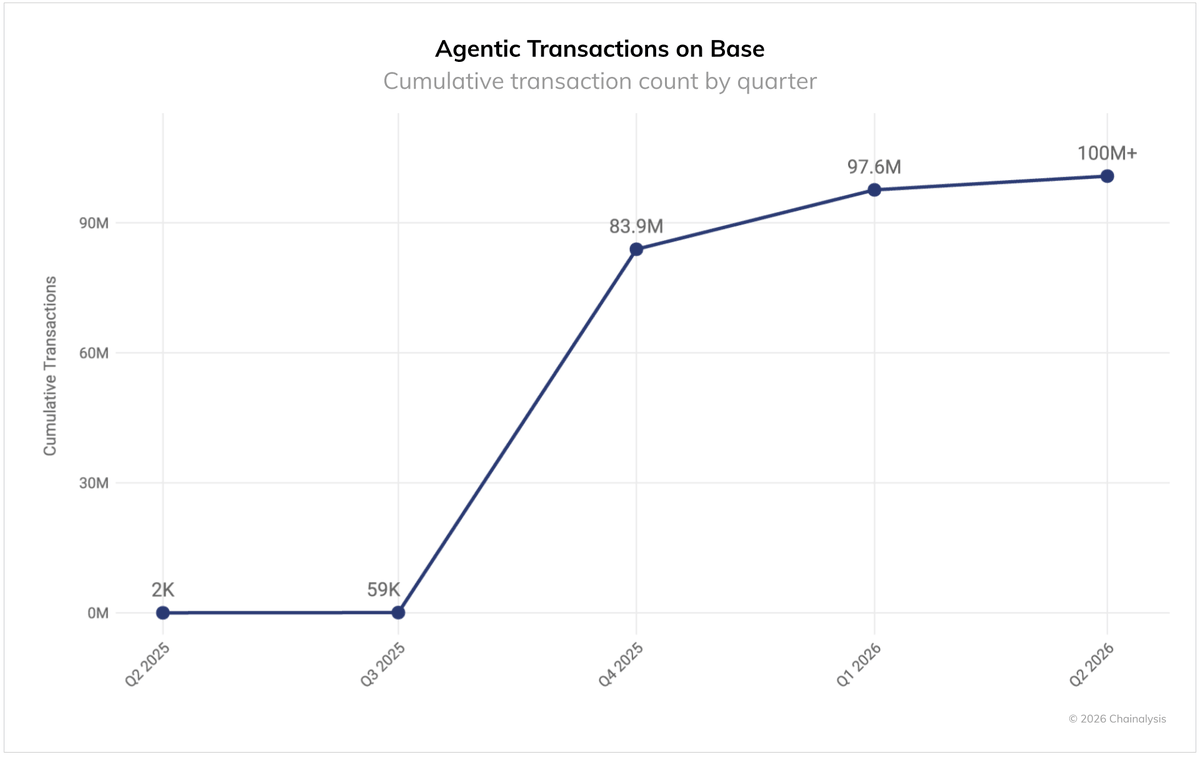
Early activity has already moved past the demo phase. Chainalysis has tracked more than 100M x402 agentic transactions on Base through Q1 2026, and since April, the Linux Foundation has become the neutral home for x402. This matters because it moves x402 from a Coinbase-originated experiment toward open internet infrastructure.
Additionally, the data also points to an evolution in the agentic payment story. Much of the first x402 activity came from purely speculative behavior, including pay-to-mint experiments. This doesn’t weaken the case for the tech as it’s usually how things gets stress-tested in crypto.
Retail market finds the mechanism first, games it, pushes it to the edge, and proves whether the system can handle real usage.
Base was the perfect environment for the first phase. It had the distribution, low fees, stablecoin rails, developer activity, and enough retail attention to turn x402 from an idea into something with actual transaction history.
The mistake would be assuming that the first venue for agent payments automatically becomes the final venue for the entire agent economy.
The Market Is Going to Split
The agent economy is not a single market. It’s going to split into at least two.
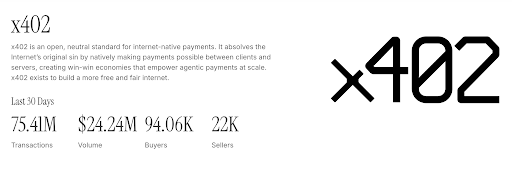
The first side is the consumer and experimentation layer: agents buying APIs, paying for content, accessing data, interacting with apps, minting assets, and creating high-frequency payment loops. This market rewards speed, low cost, distribution, and developer mindshare.
The second side is much harder: institutional agentic finance.
This is where agents are no longer just paying a few cents for access to a resource but interacting with tokenized assets, stablecoin treasuries, real-world collateral, fund workflows, cross-border settlement, credit products, insurance rails, and regulated counterparties.
That market has a completely different checklist.
Can the agent be identified? Can its permissions be constrained? Can the transaction be audited? Can compliance rules be enforced before funds are moved? Can an institution explain the workflow to its own risk team, legal team, and regulators?
That’s where the current agent economy is still in its early stages. Payments are becoming real, but institutional trust is still being built.
The same pattern we’ve seen across crypto before. The first wave of adoption proves what is technically possible. The second wave asks whether the system can support serious capital.
DeFi proved lending and trading could work onchain, while RWAs asked whether real assets could move through those same rails, now AI agents are pushing discourse into the next version of that question: can autonomous software safely participate in the financial markets?
The Real-World Adoption Is Already Here
This shift is not isolated to crypto.
Google announced AP2 to support secure agent-led payments across platforms. Shopify is building around agentic commerce, where AI interfaces can connect users directly into merchant checkout flows. Mastercard has been working on agentic commerce and machine-led payments because the traditional payments world sees the same thing crypto sees: the front end of commerce is changing.
People will still buy things, but the interface around that purchase is evolving. Instead of searching across ten tabs, comparing options manually, entering payment details, and completing checkout, users will increasingly delegate parts of that process to agents.
For everyday consumer commerce, that means better discovery and faster checkout.
For financial markets, it means something much larger is brewing.
An agent doesn’t just need to buy a pair of shoes. It may need to rebalance a portfolio, pay for a data feed, verify counterparty risk, route capital across chains, settle with another agent, and log the entire workflow in a way an institution can defend later.
This is why the payment layer isn’t enough.
A real and growing financial market needs coordination, identity, compliance, and financial-grade settlement.
The Missing Layer
Crypto has always been good at permissionless experimentation. However it’s been much weaker when the buyer is an institution with a compliance department.
This matters because the biggest pools of capital will not let autonomous agents move freely across public rails without implementing guardrails and controls. A trading bot paying for an API is one thing. An agent touching tokenized Treasuries, stablecoins, private credit, or cross-border settlement flows is another.
Agents will need more than just cheap blockspace.
They’ll need an execution environment where autonomous activity can still fit inside institutional requirements. Fast settlement matters, but so does identity, policy logic, auditability, permissions, and compliance-aware transaction flows.
That is the angle projects like @Pharos_network are trying to own.
Enter Pharos
Pharos is an EVM-compatible Layer 1 built by former Ant Group leadership, this matters.
Ant Group’s background isn’t crypto speculation specific but rather payments, financial infrastructure, and digital commerce at massive scale. Pharos feels like the onchain reflection of this background: build the rails first, make them compliant enough for serious capital to enter, then open them up to new financial workflows.
Their network is built around high-throughput financial activity, with 30,000 TPS, sub-second block times, dual VM support across EVM and WASM, modular SPNs for application-specific execution, and built-in ZK-KYC / programmable AML.
Outside of performance, the design is key to Pharos’ mission.
Beyond just trying to be another fast L1. Pharos is trying to be a financial-grade execution layer for RealFi, RWAs, stablecoins, and AI agents that need to interact with real economies.
That is the key distinction.
If the first phase of agentic payments was about proving machines can pay, the next phase is about proving machines can be a part of finance while adhering to compliance necessary for institutions to onboard capital.
Why Anvita Changes the Story
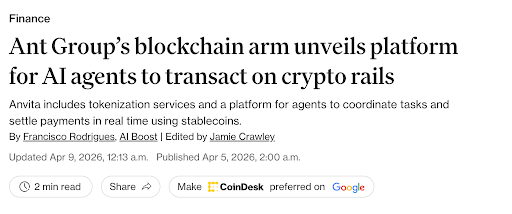
This is where Ant Digital Technologies’ Anvita becomes important.
Anvita was launched as infrastructure for AI agents and tokenized assets. It has two core products:
- Anvita TaaS focuses on institutional RWA tokenization, custody, and treasury tooling.
- Anvita Flow gives AI agents a place to register, discover each other, coordinate tasks, and settle payments in real time.
In my opinion, this tells me everything I need to know about where the market is moving to.
Anvita goes beyond asking whether agents can transact and focuses more on coordination around assets, services and workflows.
That is a much more interesting question.
Agents paying a few cents for an API call is useful, however an agent interacting with tokenized financial assets, processing stablecoin payments, coordinate with other agents, and operate inside compliance-aware rails is a completely different category.
Where x402 has given agents a payment standard, Anvita Flow gives them a coordination layer.
This places Pharos as the settlement environment designed for RealFi and institutional-grade activity.
The RWA Foundation Came First
The reason this thesis feels cleaner is primarily that Pharos was already building toward RealFi before the agent narrative hype kicked off.
Its core positioning has been tokenized financial products, stablecoins, payment systems across compliance centric infra and institutional-grade assets while also publicly pointed to its work with Ant Digital Technologies around a $1.5B RWA exchange pipeline.
So their AI agent push isn’t some random pivot but rather a focus onto where the next user class for rails that is already being built.
If real-world assets move onchain, agents eventually need to interact with them this is inevitable
If stablecoins become the settlement layer, agents eventually need to spend them.
If institutions tokenize assets, agents eventually need permissioned ways to route, manage, and automate those assets.
The agent economy needs money and RealFi is where capital is moving to.
The Test
From June 8 to July 24, Pharos and Anvita Flow are running a Skill-to-Agent Dual Cascade Hackathon with a 125,000 $PROS reward pool.
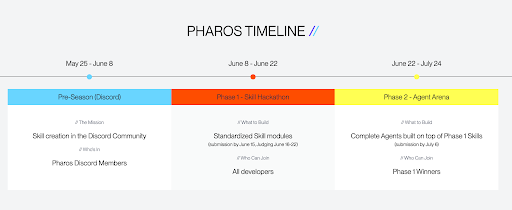
The structure is more interesting than a normal build-and-submit campaign.
Builders start by creating “Skills”, which are reusable modules an agent can call for things like data fetching, content generation, onchain actions, payments, or other functional tasks.
The “Skills” then get composed into full Agents that can live on Pharos through Anvita Flow.
The goal here goes beyond agent demos, but more so focused on building reusable agent infrastructure other builders can actually leverage.
An Agent Ecosystem.
TLDR:
Build Skills → Compose Agents → Serve Users
That’s how a network effect begins. Not through announcements, but through repeatable components that other developers want to use.
The Bet
The first major milestone was @Base proving that agent payments can work onchain. Pharos is betting the next milestone will look different.
The chain that wins the first wave of x402 activity may not be the same chain that wins institutional agentic finance. Retail agents need cheap settlement and distribution. Institutional agents need cheap settlement, identity, auditability, compliance, and access to tokenized assets.
That second market will move slower. It will be more competitive, and it probably will not be as loud as the speculative phase.
But if agents are going to be exposed to serious capital, this is the market that matters most.
The first inning of the agent economy was about payments. The next inning is about whether software can safely participate in finance.
If you have been paying attention to the AI space over the past year, you understand that an agentic economy is becoming inevitable.
The bet is that when agents start touching real assets, Ant Group’s playbook matters.
And Pharos is trying to bring that playbook onchain.
If you want to test the thesis directly, the AI Agent Carnival is live here:
Round 1 closes July 10, 2026.
Winners are expected three days later.
Related articles

The Truth About AI Consulting (After 87 Clients and 4 Years)
Over the last 4 years I've spoken with thousands of business owners about AI and automation.

How to Turn One TikTok Video Into a Global Income Stream
You spend hours researching an AI tool, writing a script, recording the video, and editing it into something genuinely useful.

I Brutally Modified My Front-End Design Skill ~ Now My UIs Don’t Look Like AI Crap
To create a custom Claude skill, navigate to Customize > Skills in your Claude interface, click the + button, and select + Create skill